

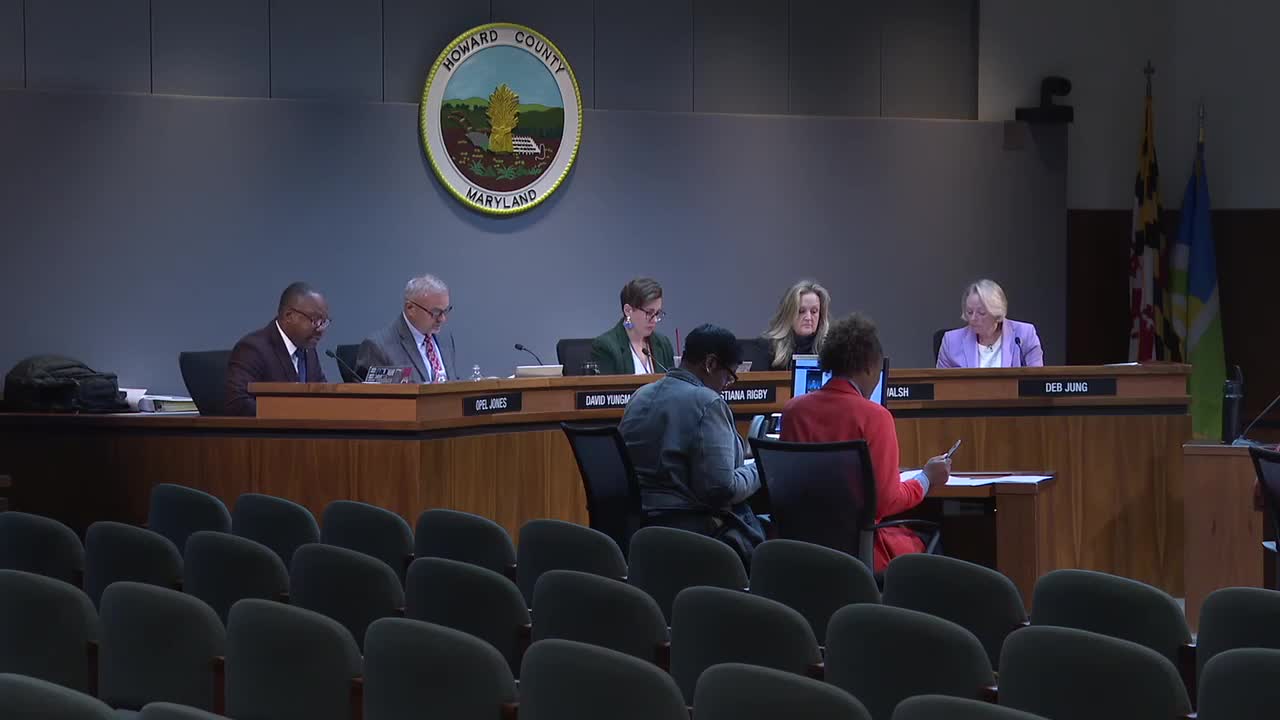


ELLICOTT CITY, Md. — Howard County Executive Calvin Ball has vetoed two County Council bills, one that would have added new rules for certain nonprofit grants and another dealing with solar projects on farmland.
Ball vetoed Council Bills 58 and 59 after reviewing the measures and public testimony, his office said. The council passed both during its final session on Oct. 30, 2026.
The nonprofit grants bill
Council Bill 58 would have changed how the county awards and manages certain grants to nonprofit groups. First introduced in September 2026, the bill was later narrowed to apply only to grants used to buy, build or redevelop property. It added more than 20 requirements for nonprofits receiving those grants, with some rules applying only to grants of more than $1.5 million.
The bill grew out of public concern over a $25 million grant given to Columbia Community Concepts to build a community center. Council member Deb Jung, who sponsored the bill, previously said that type of grant had lacked oversight.
"Those particular types of grants in the past really lacked any guardrails," Jung said during earlier reporting.
But Ball said the bill went too far. In his letter to the council, he questioned where the $1.5 million threshold came from and why it would apply to larger grants but not smaller ones.
"It became clear that the true intention of the bill was to target a specific project that had received funding from the County – including approval by the County Council – in prior fiscal years," Ball wrote.
Ball said he agreed with nonprofit groups that testified against the bill and called for a fuller study of the county's grant process.
The solar bill
Council Bill 59 would have required extra review of solar projects on farmland. It was sponsored by council member David Yungmann, who said it aimed to address confusion created by new state laws.
Ball said the bill conflicts with Maryland's 2025 Renewable Energy Certainty Act, which limits how much local governments can restrict certain solar projects. He warned that if the county passed the bill and it was challenged, a court could strike it down, putting more than a dozen pending solar projects worth more than $83 million at risk.
Ball also said the bill could cause costly delays. Recent federal tax law changes set a Dec. 31, 2027, deadline for projects to qualify for a federal tax credit, and the county found nearly $25 million in those credits could be at risk. Slowing projects across 270 acres of farmland could also cost local farmers about $16 million in income over 25 years, according to Ball's office.
Ball said the extra rules were unnecessary because the county already has the authority to manage solar development on preserved farmland.
"By delaying and thus potentially thwarting commercial solar development, CB59 could significantly undermine our energy independence and affordability as skyrocketing energy costs negatively impact Howard County residents and businesses," Ball wrote.
Maryland's renewable energy rules require 14.5% of the state's electricity to come from in-state solar by 2030, and Ball said the state is roughly halfway there.
 Facebook
 TikTok
 YouTube
 Instagram
 Threads
 X
This story was initially reported by a journalist and has been converted to this platform with the assistance of AI. Our editorial team verifies all reporting on all platforms for fairness and accuracy.

