

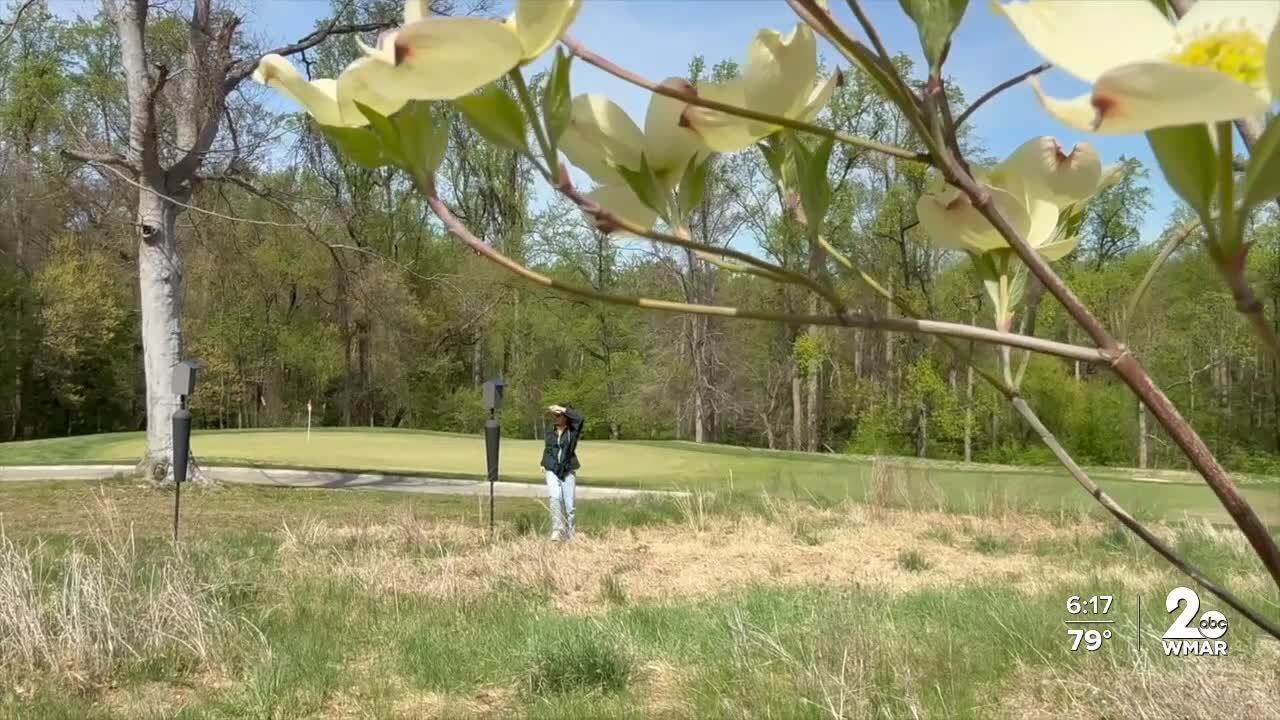


COLLEGE PARK, Md. — The University of Maryland Golf Course is transforming into a living laboratory, providing students with hands-on experience in environmental science and conservation.
Laura Russell, director of special projects at the University of Maryland Golf Course, networks to make the space welcoming for golfers, birds, bugs, and students.
"The more student involvement we have, the more we learn, and the more this university is providing a living laboratory," Russell said.

WATCH: UMD students are turning the campus golf course into a living lab!
Mario Dajani, a sophomore studying physics and math, and Preston Jackman, a second-year environmental science and policy student, took on the challenge of fixing a rain garden on the course. Both students are part of the College Park Scholars Program.
"This is pretty bad. This is full of rocks and sediment and it’s not actually doing its job," Dajani said.
The rain garden project started as an assignment to create a proposal for the University Sustainability Fund. The students went further by submitting the proposal and were awarded funds to put their plan into action.
"I'll be honest, I wasn't sure we'd get this far, but I'm very grateful that we were able to," Jackman said.
Russell sees the vast open spaces of the golf course as an opportunity to provide much-needed habitat.
"I started by reaching out to as many departments of environmental science and technology and the extension program and, um, asking people for ideas," Russell said.
After a storm toppled hundreds of trees in 2022, the golf course coordinated with the University of Maryland student chapter of the Audubon Society to install birdhouses. Students now participate in Nest Watch, a national citizen science effort to gather data on the health of bird populations.
Lynn Hui, the Nest Watch committee chair for the University of Maryland Audubon Society, works as a citizen scientist to further the understanding of bird habitats.
"With birds on the decline because, you know, deforestation and habitat loss and climate change, um, scientists really need to keep an eye on how birds are doing," Hui said.
"This data is really important for the scientific community because, um, birds are kind of in decline. Every week or so you open nest boxes and kind of like check to see if there is a nest, you know, how the nest is doing," Hui said.
The golf course creates a balance with nature that nurtures the careers of young scientists and engineers.
"Without the student community to support it, wouldn't be able to maintain them all, and that's a critical piece to a successful, um, housing for birds," Russell said.
This story was reported on-air by a journalist and has been converted to this platform with the assistance of AI. Our editorial team verifies all reporting on all platforms for fairness and accuracy.

