



HARFORD COUNTY — “The voices stop when I’m with the horses.”
Those seven words came from an anonymous veteran who participated in Chesapeake Therapeutic Riding’s Horses and Heroes program in northern Harford County.
For the nonprofit, the comment captures what staff members say can happen when veterans step outside a traditional clinical setting and spend time with a horse: a chance to slow down, focus and simply be present.
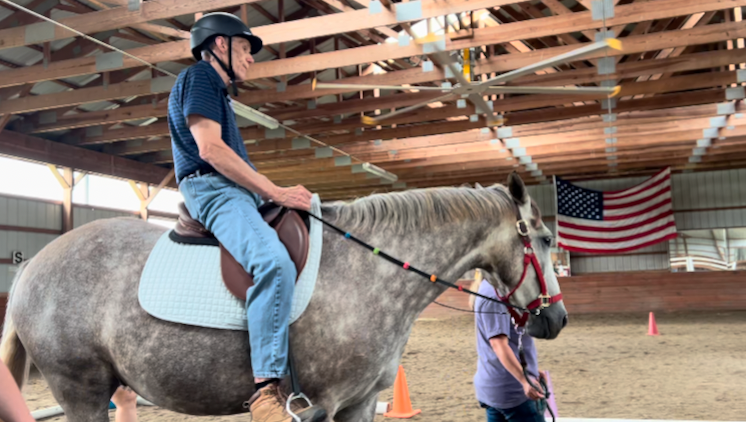
Some veterans arrive hesitant to interact with the animals. Over time, CTR says they may begin grooming a pony, leading a larger horse, navigating obstacles or eventually getting into the saddle.
Some even develop a bond with one particular horse.
“Horses are non-judgmental. They live in the moment and they give real-time feedback,” founder and executive director Cathy Schmidt said.
Schmidt said horses can give veterans, service members and first responders who may experience hypervigilance an opportunity to slow down.
“The horses allow these men and women to slow down, check in with themselves, to breathe, to be present,” she said.
Schmidt had wanted to serve veterans with horses for years, but initially did not know how to get the program started.
Then she met a World War II veteran she knew as “Doc.”
Schmidt said the two crossed paths outside her accountant’s office. Doc noticed the magnetic sign on her vehicle, wrote down the phone number and called her later that day.
He talked with Schmidt about the connection he had observed between veterans and horses, helped point her toward federal funding opportunities and became an early supporter of CTR’s effort to work with veterans.
“Two years ago, Doc passed away at the age of 100. Yeah, but he was always a champion of the work that we did,” Schmidt said.
Schmidt began working toward a partnership with the VA Maryland Health Care System in 2008. CTR began serving veterans through that partnership in May 2018.
Today, CTR says Horses and Heroes serves about 100 veterans each year and has served more than 700 veterans since the programming began.
Why horses?
Horses communicate largely through body language and respond to what is happening in the moment.
CTR says working with them can require participants to regulate their energy, communicate clearly, problem-solve and build trust.
Activities vary depending on the veteran and program, but can include grooming, leading, groundwork, horsemanship and adaptive riding.
CTR works with veterans living with challenges including PTSD, traumatic brain injury, military sexual trauma, anxiety and substance use disorder.
Schmidt stresses that CTR staff members are not clinicians. She describes the work as equine-assisted services, with VA professionals providing the clinical component when appropriate.
Schmidt also sees a connection between military service and the way horses behave in a herd.
When some horses lie down to rest, others remain standing and alert. Eventually, they switch.
“The herd looks out for each other,” Schmidt said.
It is an idea familiar to many who served.
“Never leave anyone behind. I’ve got your 6,” she said.
Schmidt said working with horses can also encourage veterans to practice self-care. Even something as simple as brushing a horse can provide a quiet, calming task.
CTR uses the Warwick-Edinburgh Mental Wellbeing Scale with participating veterans. Schmidt said the organization has seen veterans report feeling more positive, connected and present as they move through the program.
Anonymous veterans have also described feeling calmer, gaining confidence and learning trust and emotional control while working with CTR’s horses.
Horses and Heroes is offered at no cost to participating veterans.
The program relies on grants, fundraising and donations. Support has included the VA Adaptive Sports Grant, Sheila E. Hixson Behavioral Health Services Grant, Maryland Department of Veterans Animal Services Grant, PNC Foundation and contributions from veterans organizations, businesses and individuals.
CTR’s veteran programming includes introductory unmounted activities, adaptive riding, programming for visually impaired veterans, occupational therapy and mental health groups from Perry Point, and veterans participating in the VA Medical Foster Home program.
Fall 2026 Horses and Heroes programming begins the week of Sept. 7 and includes both mounted and unmounted opportunities.
For Schmidt, the mission also has a personal connection. Her father served in the 82nd Airborne and her stepfather in the 1st Cavalry during the Korean War.
She said providing equine-assisted services to veterans is one way she can honor the lives of service they led.
“You don't have to live something in order to love what you do for others,” Schmidt said.
Veterans interested in Horses and Heroes are encouraged to connect through the VA Maryland Health Care System, which can also help connect them with other services for which they may be eligible.
Perry Point VA Medical Center: 410-642-2411
Baltimore VA Medical Center: 410-605-7000
Chesapeake Therapeutic Riding is located at 1136 Priestford Road in Street, Maryland.
Learn more about CTR’s Horses and Heroes program
Veterans do not have to be in crisis to seek help. The VA offers mental health, PTSD and suicide-prevention services.
Anyone experiencing a crisis can contact the Veterans Crisis Line 24 hours a day:
- Call 988, then press 1
- Text 838255
- Connect through confidential online chat at the Veterans Crisis Line
Veterans Crisis Line
VA Maryland Health Care System
This story was reported on-air by a journalist and has been converted to this platform with the assistance of AI. Our editorial team verifies all reporting on all platforms for fairness and accuracy.
