

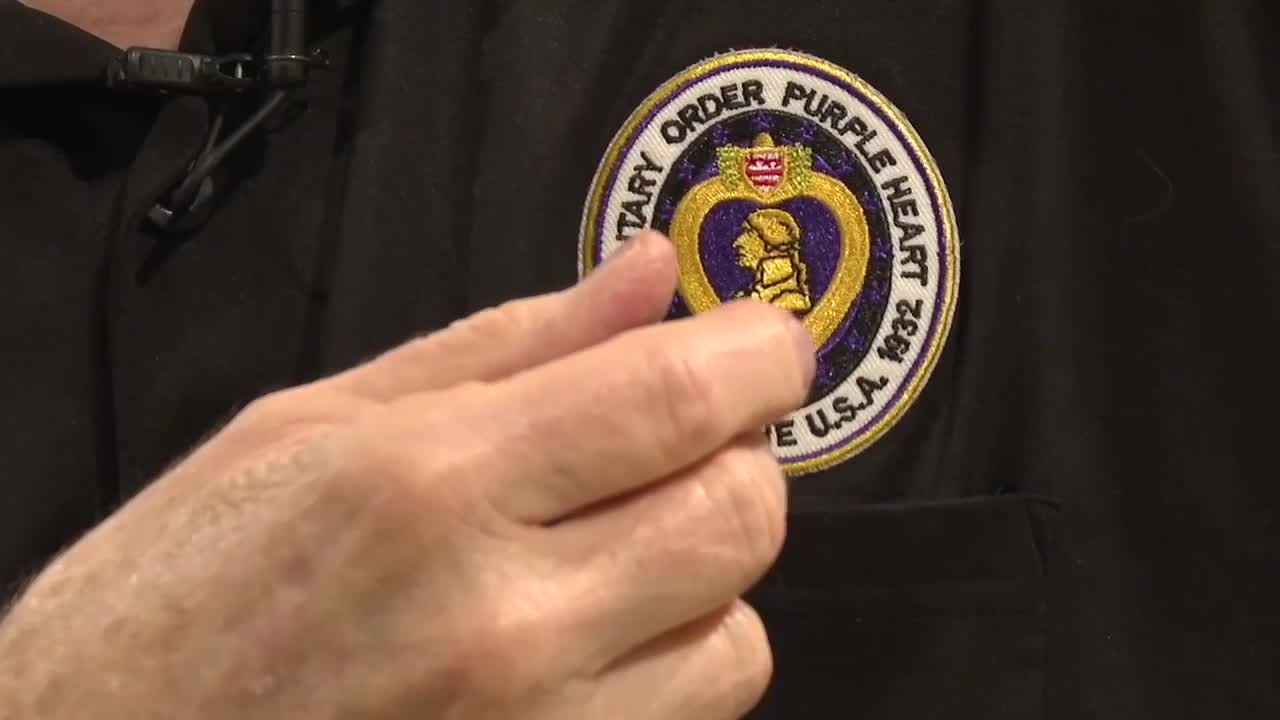


BALTIMORE COUNTY — Friday is Purple Heart Day, honoring the service members who were wounded or killed while serving the United States.
Army veteran Lee Chambers entered the Army in 1967 and was trained to operate a 106 recoilless rifle, an anti-tank weapon mounted on the back of a Jeep.
When he arrived in Vietnam, however, Chambers said his unit told him it did not have the weapon. He was instead assigned to be a radio telephone operator for his platoon sergeant, keeping the unit connected while soldiers were in the field.
One day, Chambers and the other soldiers were told they would take part in a combat assault by helicopter into a “hot” landing zone. They were warned to expect incoming fire when they jumped from the aircraft.
Chambers boarded the final helicopter with his platoon sergeant, a medic and another radio operator.
“The next thing I know is there was a huge explosion above the helicopter,” Chambers said. “And we started descending like you were on an escalator bumping down on your behind lower and lower.”
As the helicopter fell, Chambers watched the faces of his platoon sergeant and the medic, hoping their reactions would tell him how serious the situation was.
“They were poker faced,” he said. “They didn’t give me any indication how serious it was.”
Chambers then saw his helmet slowly lift from his head. He reached out to grab it.
“And it was instant darkness,” he said.
Chambers said he did not feel as though he had a body or was floating. He only felt as though he was waiting for someone to tell him where to go.
When he regained consciousness, Chambers was lying in a rice paddy.
“I was in pain from my head to the tip of my toes,” he said. “I couldn’t tell where the pain was coming from. All I knew was it was excruciating.”
Chambers opened his eyes but could not see. When he tried to touch his face, he could not move or feel his arms. He also could not feel his legs moving.
“I thought I was blind, I lost my arms, and I probably lost my legs,” Chambers said. “I started to cry.”
Chambers passed out again. A soldier later found him, pulled him from the mud and helped get him to an aid station.
An investigator later told Chambers the pilot had attempted to land the damaged helicopter rather than allow it to fall straight down. The aircraft struck a rice paddy berm, killing the pilot and a door gunner.
The co-pilot suffered a serious head injury. Chambers’ platoon sergeant was trapped beneath the aircraft and suffered a broken back. The other radio operator lost his foot.
The medic had jumped from the helicopter before the crash and injured his back. Despite his injuries, Chambers said the medic returned to the burning aircraft and pulled people from the wreckage. He was later awarded the Silver Star.
Chambers was taken to the 67th Evacuation Hospital, where doctors treated a severe wound that left his scalp open.
“They spent a lot of time getting the rice paddy mud out of, off of my skull,” Chambers said.
Because he had suffered a head wound, Chambers said doctors could not give him pain medication during the procedure.
“I said, ‘I wish you were having this pain,’” he recalled.
Chambers later discovered he could not walk because of his leg injury. He remained in the hospital for about a month before returning to his unit on light duty.
A general presented Chambers with the Purple Heart while he was recovering.
“It was a big deal in the hospital because this general came onto our ward and was pinning Purple Hearts on the patients,” Chambers said.
Chambers kept the medal in its box inside his rucksack. After returning to his unit, he discovered someone had gone through his belongings and stolen it.
“They left the box though and the ribbon,” he said.
While stationed at Fort Rucker, Alabama, Chambers met another soldier who worked in awards and decorations. The soldier offered to replace his stolen Purple Heart and asked how many he wanted.
Chambers requested three.
“The next time I got home on leave, I gave one to my mama and one to my girlfriend, and I had one for my uniform,” he said.
When Chambers returned home from Vietnam, he encountered some of the anger and division surrounding the war.
While traveling through a California airport in his Army dress uniform, a young man approached him and asked about the Purple Heart ribbon.
“He said, ‘Oh, that’s because you’re wounded, right?’” Chambers recalled. “So, yeah, and he says, ‘Serves you right.’”
Chambers said he had been warned that returning troops could face hostility, but he was still stunned.
“He just walked away,” Chambers said. “And I just stood there.”
Chambers continued serving through the Army Reserve before transitioning into the retired reserve in 1993. He estimates his military career spanned about 26 years.
Over time, Chambers began to recognize how fortunate he was to survive.
“I know that I’m here for a purpose,” Chambers said. “I know I have a lot to give back that I never thought how—never reflected on how fortunate I am. Not to have just survived, but how fortunate I am.”
Chambers volunteered for 10 years in the hospice unit at the Loch Raven VA Medical Center. He helped provide bags for families who needed to carry home the belongings of veterans who died in hospice care.
He now tries to visit a 100-year-old World War II veteran and Purple Heart recipient at least once a week.
“He is so glad to see me that that lifts me up too,” Chambers said.
Nearly six decades after the helicopter crash, Chambers said his military service continues to shape the way he lives and treats others.
His message this Purple Heart Day is simple.
“Be good to yourself and be good to others,” Chambers said.
