

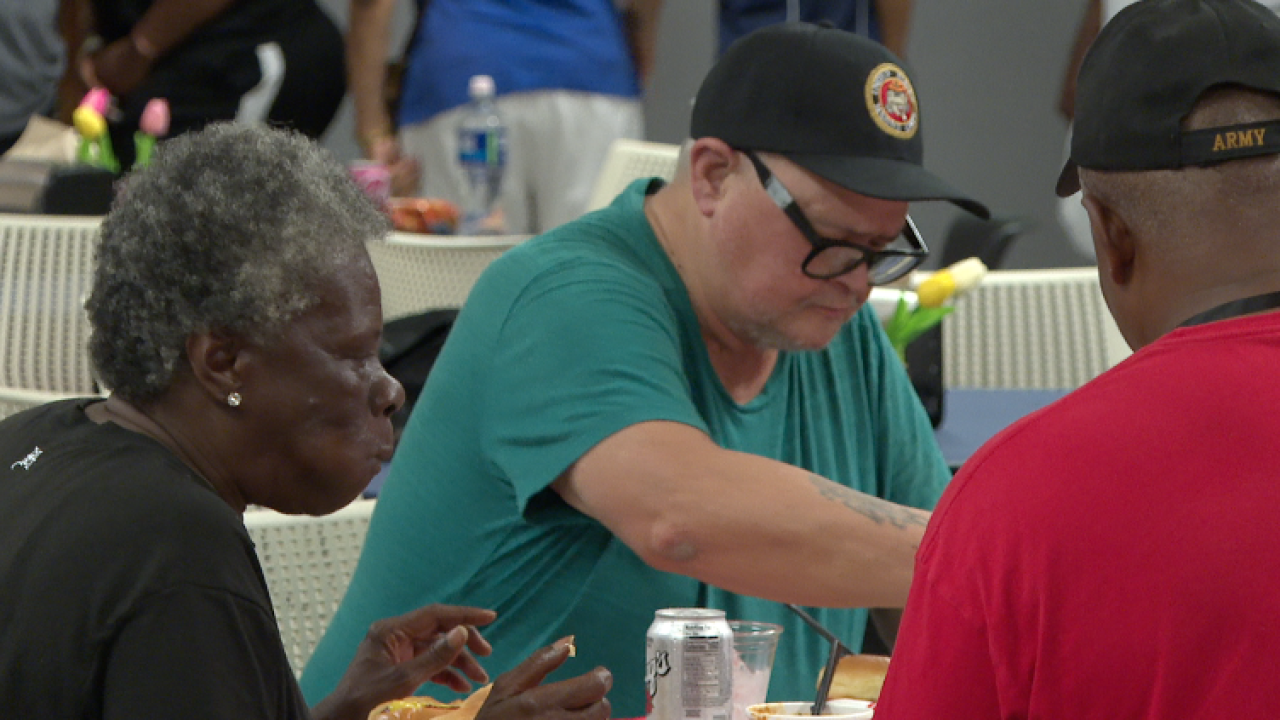


BALTIMORE — The mission at the Maryland Center for Veterans Education and Training was clear Thursday: bring veterans, families, service organizations and community partners into the same room — and make sure residents know the support around them is active, visible and available.

Baltimore veteran nonprofit cookout brings veterans and families together
BGE volunteers and members of BGE’s Exelon Military Actively Connected employee resource group, known as EMAC, helped prepare and serve a cookout-style meal for MCVET residents and community partners during a friends-and-family-style gathering at the Baltimore veterans organization.
The event brought together MCVET residents, employees, families, BGE volunteers, community partners and veteran service leaders. Organizers expected about 150 to 200 people to attend.
The gathering was designed to celebrate MCVET employees and residents, recognize veterans who completed workforce development programs and honor residents who have died. It also included a ceremonial cake cutting representing all service branches and the National Guard.
Walter “Colonel Mitch” Mitchell, second vice chairman of MCVET’s board of directors, has been with the organization since it started in 1995. He said the mission has remained direct for more than 30 years.
“The mission is to take care of homeless veterans and other veterans in need,” Mitchell said.
Mitchell, a Vietnam veteran, said MCVET began as Maryland Homeless Veterans before its name changed to the Maryland Center for Veterans Education and Training. He said that change reflected the work being done inside the building.
“The veterans were no longer homeless once they came to our program, so we had to change that name to represent what we did for the veterans,” Mitchell said.
He said MCVET’s goal is not temporary assistance — it is helping veterans return to civilian life with the tools to stay there.
“The main thing about our program, it is a total program to get the veterans that come to us to return to the civilian community as a productive citizen,” Mitchell said. “When they fell down and went into the depths of homelessness, we have everything they need to get them back on their feet.”
For Coleman Nee, national commander of Disabled American Veterans, the cookout showed why veteran service organizations need to be present in the community.
“Right here at MCVET, what we’re doing here today, that’s what DAV does every day,” Nee said. “We’re a service organization.”
Nee, a Marine Corps veteran who served during Desert Storm, said some people misunderstand what veteran organizations do.
“I think a lot of people get confused sometimes about veterans organizations,” Nee said. “Oh, you guys hang out in a club, you guys do this, you guys do that. No. DAV, we’re out in the community, and this is the community.”
Nee said the veterans at MCVET include men and women who are still working through the difficult parts of returning to civilian life.
“This is where our veterans, our brothers and sisters are, those that are having a harder time transitioning back,” Nee said. “It’s our mission, it’s our ethos as military members and as a service organization to be on the ground here supporting organizations like this and showing our brothers and sisters that we still care about them.”
Nee said he saw the impact of MCVET’s work during a tour of the facility, meeting veterans who came through the program and are now doing well.
“When you come here on your day one, what are you looking for? Hope,” Nee said. “Is there somebody here who represents me, who made a pathway forward that took me out of the life I’m in now and went to a life that’s better?”
He said events like the cookout matter because they show residents that people are still invested in their success.
“People coming in to volunteer, people still caring about them, that’s what we need as humans,” Nee said. “That’s what drives us to want to wake up the next day, do better, and try to get ourselves out of that situation.”
BGE said its participation was part of EMAC’s broader commitment to veterans and their families.
“BGE is proud to be here with EMAC, Exelon Military Actively Connected, our employee resource group,” said Nick Fertig, principal project manager at BGE. “I’m a U.S Navy veteran, and while I was in the Navy, I had an opportunity to learn a lot, and when I got out, I was fortunate enough to join BGE, a company who cares about their employees, but also cares about the community. In EMAC, we get to come together as employees, many of us veterans, as a group of people focused on supporting veterans, and we’re so happy to be here today serving a meal at MCVET.”
Expected attendees also included Secretary Edward C. “Ed” Rothstein of the Maryland Department of Veterans and Military Families and Deputy Secretary Dana Burl, who oversees Military Family Policy and Programs.
Mitchell said the cookout also reflects how MCVET views support systems. The work does not stop with the veteran alone; families and community partners are part of the mission.
“It’s just like it is in the military,” Mitchell said. “If you don’t take care of the families, then the service member won’t be productive at all. So this is a family affair.”
Mitchell said homelessness among veterans has not disappeared, despite claims in some places that the issue has ended.
“Some people think that the homeless issue is going to go away, and our experience is it hasn’t gone away and it won’t go away,” Mitchell said. “There will always be a need, as long as there’s going to be wars, there’s going to be casualties of that war.”
Nee said the takeaway for veterans watching is that the bond between those who served continues after active duty ends.
“That ethos that we had in the military, that commitment to each other, that dedication, the Marine or the soldier or the airman or the sailor on the right or the left of you — all of that transfers over,” Nee said. “It is a bond for life.”
He urged veterans and community members to get involved with MCVET, DAV or other veteran service organizations.
“We have to rely on ourselves. We have to rely on each other,” Nee said. “Getting the word out, helping to spread the word, and then having that word take action and having people come in, I think that’s the biggest takeaway I can give you.”
