



ANNAPOLIS, Md. — About 60,000 patients were forced to find new doctors or navigate complex paperwork after a contract dispute last August between UnitedHealthcare and Johns Hopkins. Now, Maryland's top insurance regulator is pushing for new legislation to prevent patients from being caught in the middle of future disputes.
For Julie Wigley, a WMAR-2 News employee living with multiple sclerosis, the split wasn't just inconvenient, it meant finding a new care team.
"So my team that I've been working with since 2010, I had to say goodbye to and move on and find all new doctors, move appointments. I did qualify for continuing care, but continuing care was only 3 months," Wigley said.
Beyond working with new doctors, Wigley also had to secure new approvals for her treatments.
READ MORE: Maryland Insurance Commissioner eyes reforms as UnitedHealthcare–Johns Hopkins standoff drags on
"And originally I got denied at first through this new hospital, new service. We were able to sort it out, but I started making calls probably in September once I realized that this was a permanent decision, and it wasn't until last week that everything got sorted out" Wigley said.
Those denials, along with short notice and confusing guidance for patients, are among the reasons the Maryland Insurance Administration introduced new legislation.
Maryland Insurance Administration Commissioner Marie Grant said the bill addresses gaps that became apparent during the Johns Hopkins-United Healthcare dispute.

An In Focus look at complaints stemming from the dispute between Johns Hopkins and UnitedHealthcare
"This bill is absolutely, I think all the tools in the toolbox we wish we had, legally, after the Johns Hopkins-United dispute," Grant said.
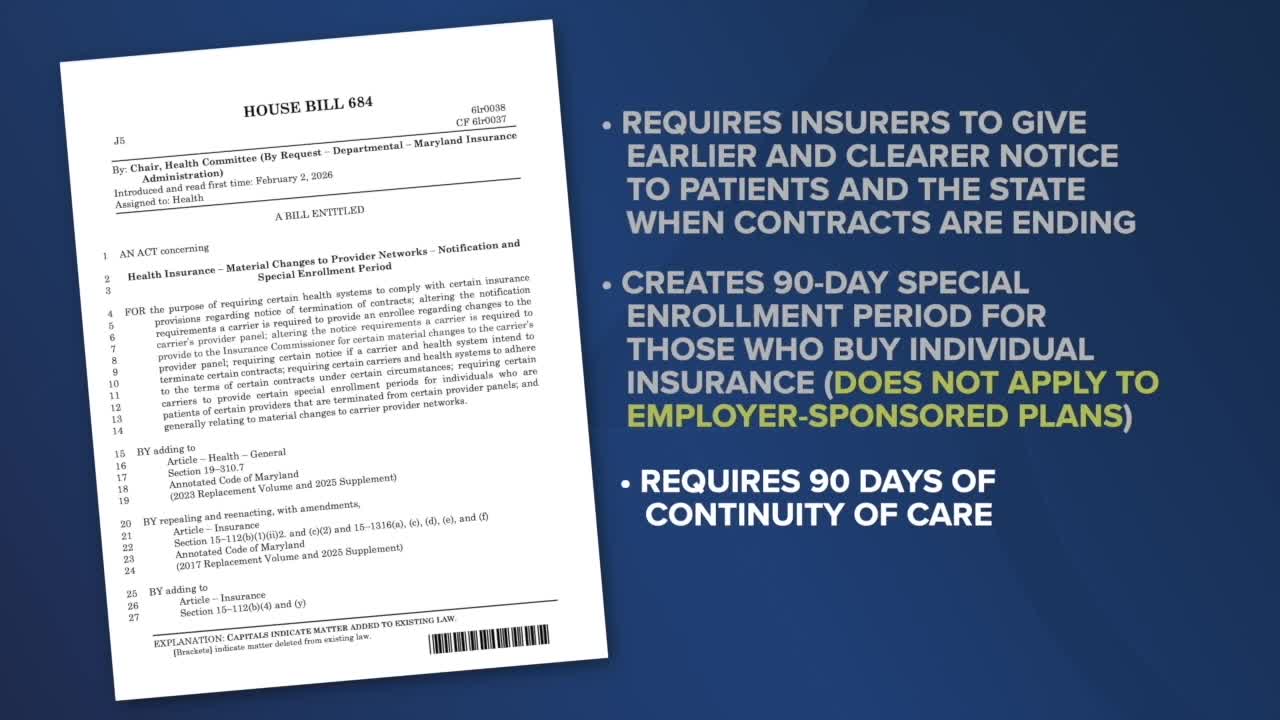
The legislation would do several things. It would require insurers to give earlier and clearer notice to patients and the state when contracts are ending. It would also create a 90-day special enrollment period for people who buy individual insurance, though it would not apply to employer-sponsored plans. In most cases, it would also require 90 days of continuity of care automatically, without additional paperwork.
Grant said the timing of the legislation is critical given broader pressures on the healthcare system.
"This legislation is important this year because I do think there are national dynamics happening that could come and hurt our market in Maryland. There's a lot of changes to federal funding for healthcare across the board and so as resources shrink that's when we start to see parties have these kinds of disputes," Grant said.
WMAR-2 News’ Mallory Sofastaii reached out to Johns Hopkins Medicine and UnitedHealthcare for an update on negotiations. Hopkins said it had no new information to share, and UnitedHealthcare has not yet responded. With no timeline for when talks may resume, Commissioner Grant said protections like these are needed now.
RELATED: Hopkins–UnitedHealthcare split: How patients are navigating care amid contract fallout
"Living with a disease that you trust your providers, you trust the doctors, you trust that friendly nurse that you see at the infusion center that you go into, to then kind of have to uproot that and find a whole new trust. It's there, but it's that process and again a disease that you're supposed to not be stressed," Wigley said.
A hearing on the Senate version of the bill is scheduled for March 4 at 1 p.m.
If you are having trouble with your health insurance, the Health Coverage Assistance Team can help — answering questions, explaining your plan, and helping you find coverage or other resources. Once you submit their form, someone will contact you within one business day. You can also find information about the Maryland Insurance Administration by clicking here.
This story was reported on-air by a journalist and has been converted to this platform with the assistance of AI. Our editorial team verifies all reporting on all platforms for fairness and accuracy.