



ANNAPOLIS, Md. — Maryland lawmakers are again pushing a bill that would move the state away from the gas tax and toward a mileage-based user fee, an idea that failed in the General Assembly last year but that supporters say may be inevitable.
The gas tax has funded roads and bridges for more than a century, but transportation experts say declining revenue is forcing the state to consider alternatives. Cars are traveling farther on less fuel, and more drivers are switching to electric vehicles.
"Before we get to a crisis situation, we want to really think about what are ways that we can keep our transportation system vibrant and running," Patricia Hendren, executive director of the Eastern Transportation Coalition, said.
RELATED: Dueling bills in Maryland: A battle over mileage fees and the future of transportation funding
Maryland has already begun making changes. This year, the gas tax is no longer the state's largest source of transportation revenue. That distinction now belongs to the motor vehicle titling tax, which increased to 6.5 percent, up from 6 percent. The state also added a 3.5 percent tax on rental vehicle sales, which were previously exempt, along with higher registration, emissions, and other fees.

An In Focus look at other updated MVA fees
"So the crossroads we're at — do we want to keep increasing these annual registration fees higher and higher in order to generate the revenue that we need? Which really doesn't reflect how much someone is using our roads," Hendren said.
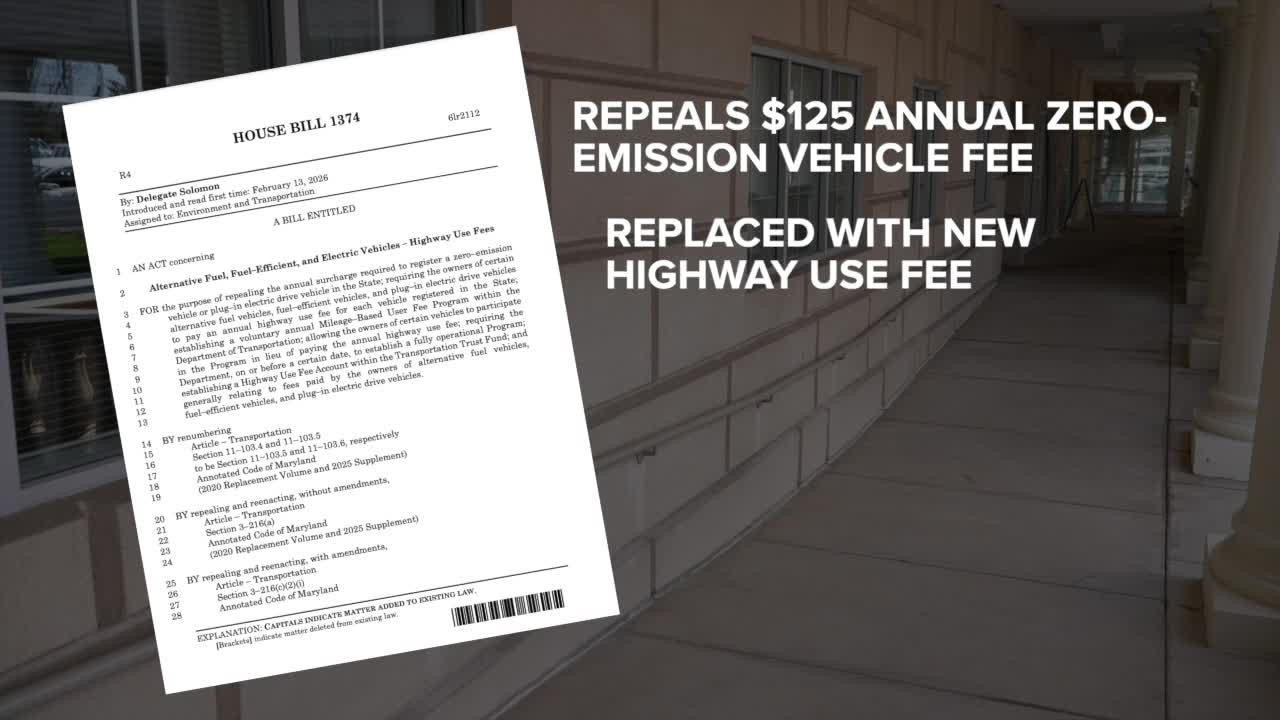
Delegate Jared Soloman (D-Montgomery County) is proposing HB1374, a mileage-based user fee as another option. The bill would apply to certain vehicles — including electric and other fuel-efficient models — repealing the $125 annual zero-emission vehicle fee and replacing it with a new highway use fee. Drivers would then pay that flat fee or choose to pay by the mile.
"So what we're looking at is how we move towards all vehicles paying by the mile versus just a portion of vehicles and having a choice between a flat fee and a distance-based approach," Hendren said.
A pilot program in Maryland found drivers paid about $23 a month under a mileage-based system, compared to about $19 through the gas tax.
READ MORE:
As fuel tax revenue dwindles, Maryland tests program charging drivers by the mile
Ditching the gas tax and charging per mile; Maryland testing new way to fund transportation needs
The idea still faces skepticism, particularly from lawmakers in rural counties.
"Anytime I hear about taxes, especially in Maryland, my guard goes way up," Delegate Terry Baker, a Republican representing Allegany and Washington counties, said during the bill hearing.
But Hendren says one surprising finding from the pilot program is that rural drivers may actually pay less under a mileage-based system.
"So right now, the rural households are driving some larger, older vehicles. So they're paying quite a bit in fuel taxes today. So as we shift to a distance-based approach, they pay less," Hendren said.
That difference amounts to about $3 less per month.
Four states have already adopted a voluntary distance-based approach: Virginia, Utah, Oregon, and Hawaii. In Hawaii, there are plans to make the program mandatory for electric vehicles, and to roll it out to all drivers by 2033.
To address privacy concerns, drivers in the pilot program can choose how they report their miles by taking a photo of their odometer, using an app, or plugging in a device.
States have taken additional steps to protect privacy. In Virginia, lawmakers passed a law limiting how driving data can be used, and data collected through the Eastern Transportation Coalition pilot programs is deleted after 30 days.
If you're curious how much you might pay under a mileage-based user fee, you can sign up for the free pilot program running now through May 31. An online tool is also available to estimate your mileage-based user fee based on the car you drive.