

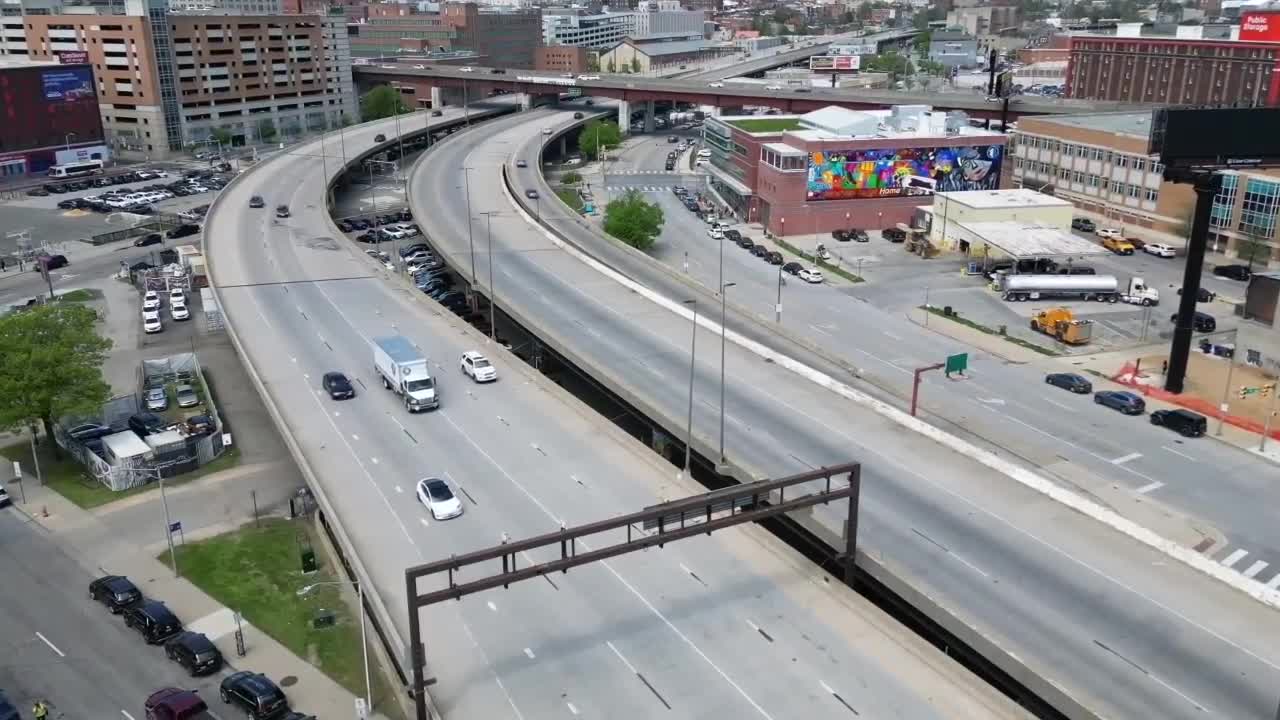


BALTIMORE — Baltimore’s transportation director says there’s still no funding, and no timeline, for a major overhaul of the Jones Falls Expressway/I-83, even as drivers report costly damage and frustration on the roadway.
At the same time, some nearby neighborhood streets are scheduled for repaving this year, including Battery Avenue in Federal Hill, where Jo Anne Stull lives.
"I have one of the best streets, comparatively, here," said Stull.
Stull questions how the city decides which roads get fixed first after repeated issues on I-83.
"At this point, I've had three flat tires. I've had two rims that need to be repaired," Stull said. "It's not even just the tires, it's the time that I've spent on the side of the road."
Because of the flat tires, she's missed her kid's sporting events, a licensing exam, and had to replace all four tires on her all-wheel drive vehicle after hitting potholes on the expressway multiple times.
"These roads are 25 MPH, certainly less traffic going on these roads. You compare it to an 83, a 295, Washington Boulevard where speed limits are much higher, a lot more traffic. I would think those would take a priority any day," Stull said. "I pay a lot for my taxes, and I live in a little house and I pay a lot, so I expect a road that I can drive down."
Baltimore City driver Paul Petrov described a similar experience.
"Yeah, both right tires, unfortunately, otherwise I would have changed the tire and kept going," Petrov said.
Despite those concerns, Baltimore City has no plans to repave the JFX and officials say they don’t know when that could change.
Mayor Brandon Scott warned in April it would cost about $300 million just to bring the roadway to an "acceptable" condition.
In a recent interview, Baltimore City Department of Transportation Director Veronica McBeth said the city does not have the funding needed for a full reconstruction and is instead prioritizing smaller road projects it considers to be in worse condition.
"We don't have current funding mechanisms to reconcrete, essentially the JFX. A lot of the roadway is concrete, and so that is a very expensive and laborious process to do that. So it wasn't or isn't on our repave programming right now," McBeth said.
Unlike most jurisdictions in Maryland, Baltimore City is responsible for maintaining its own interstate highways, including I-83 and I-295. The city relies in part on state highway user revenue to fund that work.
This year, Baltimore is set to receive about $267 million in highway user revenue, down slightly from about $272 million the year before.
Officials warn that funding is expected to drop by more than $66 million starting in fiscal year 2028, creating what they describe as a significant fiscal cliff.
When asked why the city wouldn’t prioritize improvements now ahead of that drop, McBeth acknowledged the concern.
"I think that's a great question, and it plays, highway user revenue plays a huge role in our Capital Improvement Program," McBeth said. "But in order to maintain and deal with large, huge infrastructure projects that are aging infrastructure, it requires a predictable level of funding and a larger amount of funding which we don't have."
In the meantime, the city says it will continue smaller-scale work along the corridor, including concrete patching, ramp repairs, and work on barriers and retaining walls.
"We will continue to maintain the roadways as best as we can. But as far as a major infrastructure project for I-83, it's not on the books for right now," McBeth said.
The city does plan to repave about 90 miles of roadways citywide this year, according to its Repave Baltimore tracker.
A separate rehabilitation project on I-295, which was originally expected to begin this year, is now projected to start in early 2027. Cost estimates are not yet available because the project has not gone out to bid.
The city also operates speed cameras along I-83. Under state law, revenue from those cameras must be used for camera operations and roadway safety improvements. City data shows expenses have exceeded revenue from those cameras for the last three years.
Residents can track paving progress through the Repave Baltimore online tracker or report potholes and road issues by calling 311 or filing a report online.
This story was reported on-air by a journalist and has been converted to this platform with the assistance of AI. Our editorial team verifies all reporting on all platforms for fairness and accuracy.