

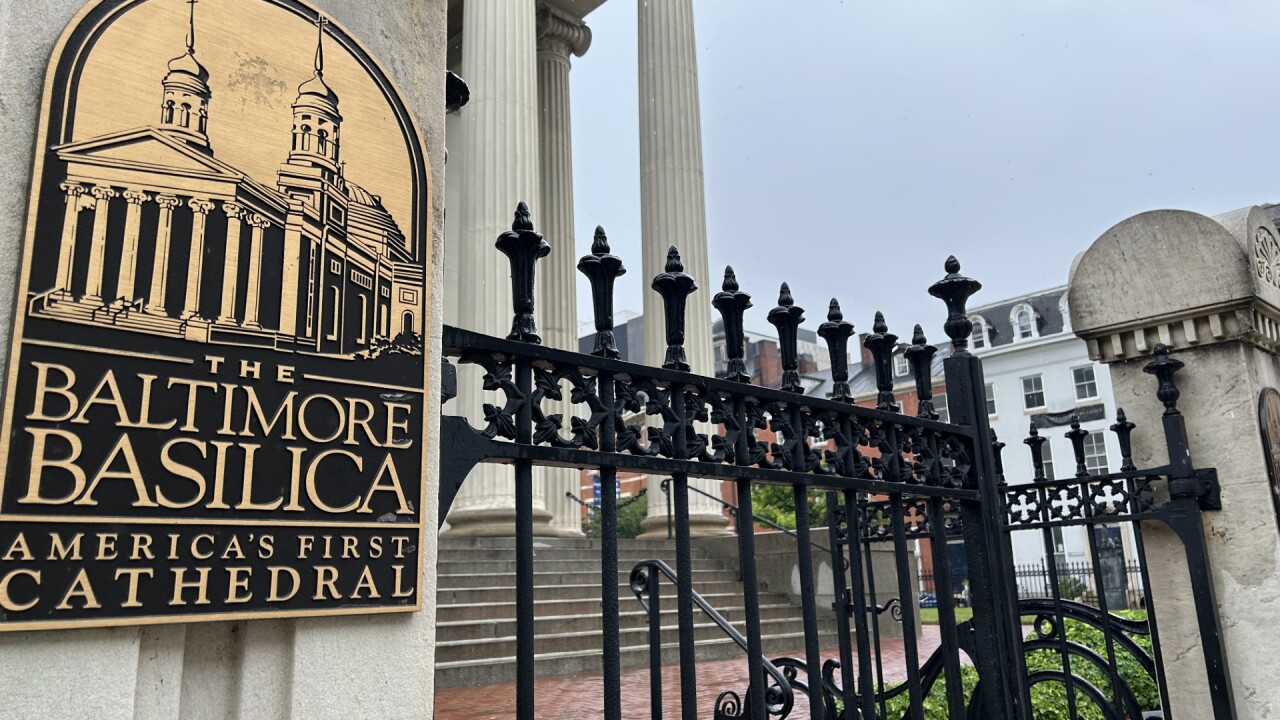


BALTIMORE — A crowd of worshippers braved the rain in Baltimore's Mount Vernon neighborhood Wednesday morning, walking in a procession from the Baltimore Basilica to the Washington Monument.
The procession followed a morning mass at the Baltimore Basilica, a national historic landmark on Cathedral Street; signs on the outside gates bill it as America's first cathedral. The building's architect also designed the U.S. Capitol Building.

Worshippers march in Mount Vernon ahead of America's 250th birthday
Fr. Michael DeAscanis, pastor of a congregation in Howard County, told WMAR-2 News about the basilica's significance in America's early days.
"Interestingly, Thomas Jefferson knew this was an important symbol of religious freedom. He was not Catholic, but he helped design the skylight of this cathedral in the dome," DeAscanis said.

The march, part of the National Eucharistic Pilgrimage, reached its halfway point at Baltimore's Washington Monument. Both structures were built shortly after the signing of the Constitution.
"And then we went up the 227 steps of the Washington Monument. And blessed our city, asked Jesus to bless our city north, south, east and west," Fr. DeAscanis said.
"I found it to be more emotional than I anticipated. It did bring tears to my eyes, choking me up. It's a beautiful moment," said Janice Tewey, a Perry Hall resident.
For Fr. DeAscanis, the pilgrimage carries a message of unity for the country ahead of America's 250th anniversary.
"We're a great nation. We have a great past. We have a promising future, but we have a lot of problems," DeAscanis said, "so that God will unite us with all of our ethnic and racial and religious differences that we remain one people."
The pilgrimage is traveling more than 1,000 miles along the East Coast, including the 13 original colonies, and ending in Philadelphia over the Fourth of July weekend. The journey continues in Annapolis, departing for Delaware on Thursday.
This story was reported on-air by a journalist and has been converted to this platform with the assistance of AI. Our editorial team verifies all reporting on all platforms for fairness and accuracy.
