

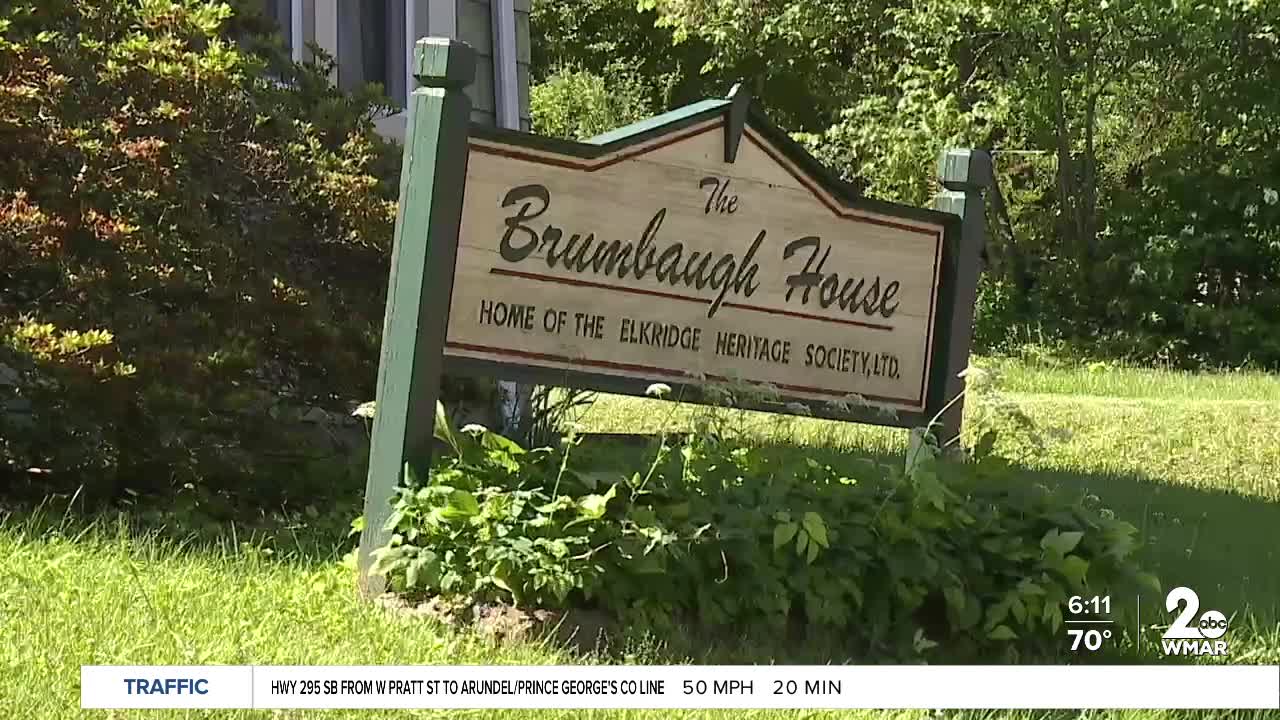


ELKRIDGE, Md. — Just off Main Street in Elkridge sits a large, Victorian-style house on a hill. For decades, it was the home and office of beloved town doctor, Dr. Benjamin Brumbaugh.
Today, it is the headquarters of the Elkridge Heritage Society (EHS) and its new museum.
"We're really trying to rejuvenate this whole idea and keep the history of Elkridge alive," said Tina Barton, one of the board members of EHS.
And what better place to have a museum about a town's history, than in a historic home. The house itself is said to have been built in the late 1800's. Dr. Brumbaugh bought it in 1920 and used it as a home and doctor's office until 1980.
"He would treat all the people in Elkridge, regardless of race, and deliver all their babies. He did a lot of home births until I think around 1940," said Barton.
EHS acquired the home in 1986 and primarily used it as a meeting space. This year, they opened up a small museum on the first floor, with exhibits showcasing the history of the town once known as Elk Ridge Landing.
Part of the first floor is set up like Dr. Brumbaugh's office, with his desk, the original couch in the waiting room, medical equipment and even viles of medicines he would use.
"One lady said she came in with a sore throat. He painted some black tar on their throat and then it's gone," Barton said.
The other half is exhibits and artifacts from Elkridge, detailing life in the early days, the Revolutionary War, up to the present day.
"There were no (Revolutionary) battles fought here, but there was an Elkridge battalion that supported the effort and there was a lot of industries," said Barton.
Elkridge sits along the Patapsco River, making it an efficient route for troops fighting in the American Revolution. Among the notable military members to pass through were Generals Marquis de Lafayette and Jean-Baptiste de Rochambeau. They were on their way to Yorktown Virginia, in what would be the last major battle of the Revolution.
Barton said its why author Paul Travers referred to Elkridge as "the crossroads of the Revolution" in his book "The Patapsco, Baltimore's River of History".
Just recently, EHS received a sycamore tree sapling from what's called a "witness tree". The original tree in Pennsylvania is said to be connected to General Lafayette, when he was injured during the Battle of Brandywine in September 1777.

"He rested under the tree and the tree's still alive, and they take saplings from it and put them places where they think are significant for Lafayette," said Barton.
Other historic landmarks in town include the Viaduct, constructed in 1835, bringing the railroad. The Elkridge Assembly Rooms on Lawyers Hill Road, built in the post-Civil War era, are still used today.
"And the rule was, and still is, that there will be no politics discussed there," said Barton. "I just like the idea that we are apolitical. The Elkridge Assembly room is apolitical, and we're trying to just find common ground and a sense of community."
The next open house at EHS is Saturday June 13 from 10 a.m. - 2 p.m. Admission to the museum is free.
