


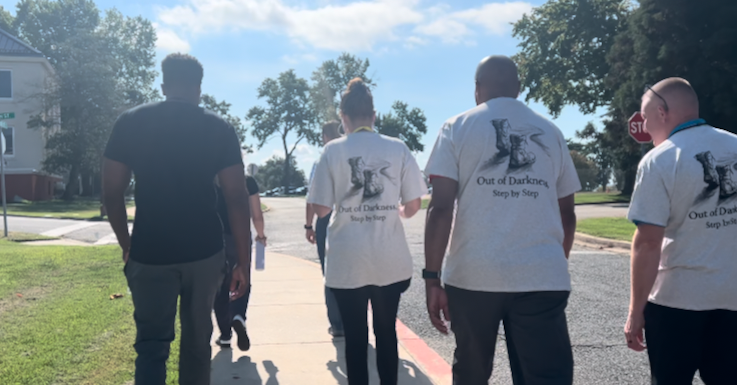
PERRY POINT — Veterans, VA employees and community members came together Wednesday at the Perry Point VA Medical Center for its fourth annual suicide prevention and awareness walk, an event focused on reminding veterans that support remains available long after their military service ends.
Among those walking was Army veteran Todd Williams, who served for 20 years.
Williams said he did not deploy during his Army career, but completed eight assignments. His military service also became closely tied to his family’s story. He met his wife while stationed in Berlin, where their daughter was born. One of his sons was later born while the family was stationed at Fort Irwin, and another was born during an assignment in Hawaii.
One of Williams’ sons later served for a year in Afghanistan.
VOICES FOR VETERANS: After losing a friend and veteran to suicide, Navy officer builds a new mission through Let’s Chow
For Williams, showing up for veterans after they leave the military is just as important as supporting them while they are serving.
“I think it's important to not just honor theirs or, you know, take care of them when they're in active duty, but also afterwards because that becomes a little bit more of a challenge because you're no longer in a facility with a unit, that type of thing,” Williams said. “You're out and about. Sometimes people feel very alone.”
Williams said suicide prevention is also a subject that touches his family professionally, with relatives working in the social work field.
While he said he has not personally known a fellow service member who died by suicide, he has heard stories surrounding the issue.
“There's certainly always whispers about it,” Williams said. “You never really know what happens sometimes.”
He said that uncertainty is part of what makes checking on people so important.
“You never really know what's going on in people's minds,” Williams said.
For him, that same approach carries into his role as a father and grandfather. Williams has five grandchildren and said he tries to keep an eye on his children, grandchildren, son-in-law and daughters-in-law.
The goal, he said, is making sure they know they have someone in their corner.
“Just keeping so they know that people care,” Williams said. “That's the bottom line.”
For Army veteran Katisha Smittick, the walk carries an intensely personal meaning.
Smittick served 11 years in the Army as a surgical technician and deployed to Iraq. After returning home, she said two soldiers she served with died by suicide.
“As a veteran, suicide is very high, and I had two of my soldiers commit suicide when we got back from Iraq, so it's very near and dear to my heart,” Smittick said. “And so I'm here to support in all aspects.”
VOICES FOR VETERANS: Army veteran shares how military sexual trauma led to a suicide crisis and a mission to help others
Her support was visible throughout the event.
Smittick designed shirts worn by some of the walkers, featuring imagery rooted in a military battlefield memorial and the phrase “Out of the Darkness, Step by Step.”
She explained that when a service member dies while a unit is deployed, fellow troops often hold a memorial before the service member’s remains return home. That memorial can include the fallen service member’s dog tags, Kevlar helmet, boots and weapon.
“When you're deployed, and you have a soldier die, we actually do a memorial for them, and this was a part of the memorial,” Smittick said. “It's usually the dog tags, the Kevlar, which is the hat, and the boots, and then we also put on their weapon and we show our respect in that aspect instead of waiting for them to get home.”
The words on the shirt carry another meaning.
Smittick said leaving the military can bring a difficult transition into civilian life, particularly for veterans dealing with post-traumatic stress, depression and anxiety.
“Out of the darkness is coming out of, you know, your PTSD, your depression, your anxiety and all those things and being able to like just walk into that brighter light,” Smittick said.
She said some veterans struggle to make that transition.
“I feel like when we come in and this transition coming out of the Army or Navy, Marines, Air Force or whatever the case may be, there's a transition period, and sometimes a lot of us don't make that transition, that transition period, because it's so hard,” she said.
Smittick said the image and message also represent her own experience.
She described her transition into civilian life while dealing with PTSD and depression as difficult. Over time, she found different outlets that helped her move forward.
“There's actually light at the end of the tunnel,” she said.
Smittick eventually became a personal chef, and cooking became one of several forms of therapy that helped her. She said traditional talk therapy is not the only way veterans can work through what they are experiencing.
“Therapy comes in so many different formats,” Smittick said. “My favorite therapy session was actually playing with the horses and painting and cooking.”
Her message to veterans who may be struggling at home is to give themselves time and seek support.
“The one thing I can say is that there is a way out, and if you just be patient, you wait. You can get out, get help, talk to people,” Smittick said. “There's actually light at the end of the tunnel and don't give up.”
All participants in the Perry Point walk received a T-shirt featuring artwork created by a veteran patient. Artwork previously displayed at the Maryland State Fair was also brought back to Perry Point for display during the event’s resource fair.
The walk is designed to bring veterans, VA employees and the surrounding community together around a message both Williams and Smittick emphasized: veterans should not have to face difficult moments alone.
 Facebook
  TikTok
  YouTube
 Instagram
 Threads
 X
X