

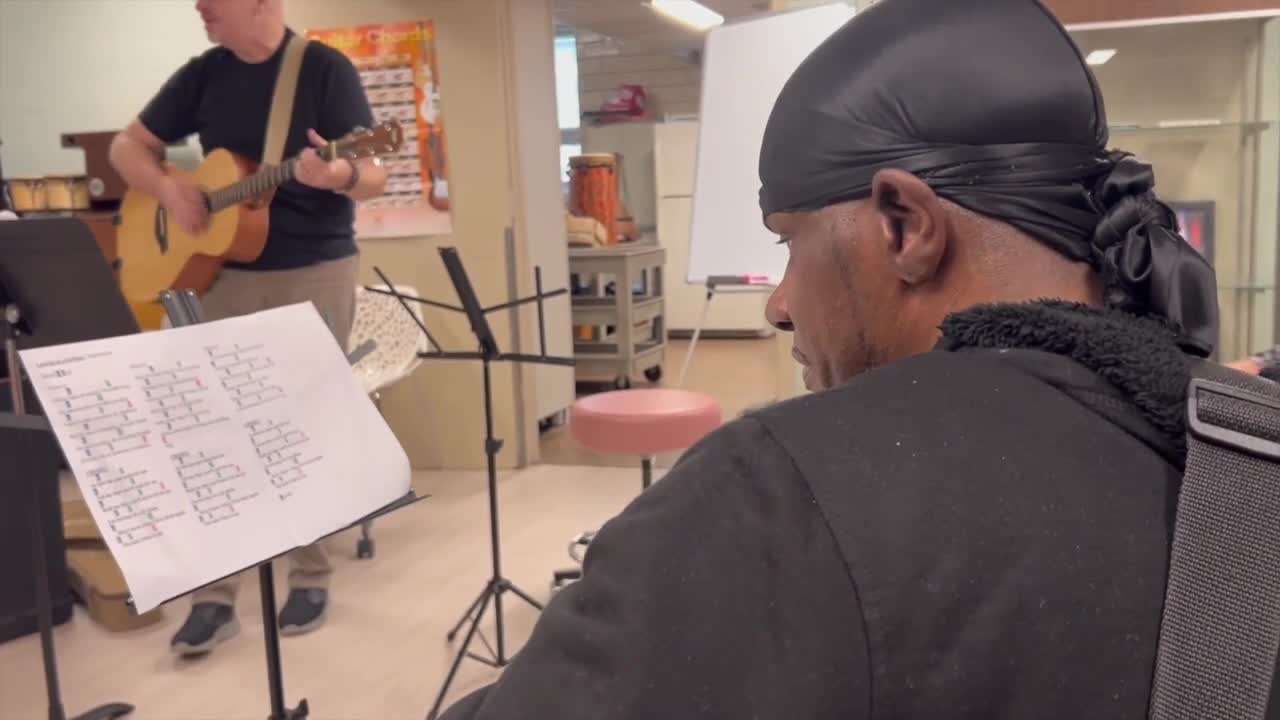


PERRY POINT, Md. — CECIL COUNTY, Md. — For some veterans, healing doesn't always come through words. Sometimes, it comes through music, a familiar melody or the simple act of sitting down with others who understand what they've been through.
At the Perry Point VA Medical Center in Cecil County, a group of veterans is discovering that picking up a guitar can mean much more than learning a new instrument.
Through the VA Maryland Health Care System's outpatient guitar therapy group, veterans are finding friendship, rebuilding confidence and rediscovering passions they once thought were lost.
For Army veteran Bill Harkins, the program has helped him turn one of the darkest chapters of his life into an opportunity for connection and personal growth.
"I had isolated for about three years prior to coming in. I hadn't played guitar in years. I didn't want to do it," Harkins said.
Harkins served four years in the Army during the mid-1990s. Years later, he found himself experiencing homelessness and struggling with isolation.
While receiving shelter and support at Perry Point, his therapist suggested he try the facility's guitar therapy program.
Initially, he resisted.
"I didn't want to play in front of other people," Harkins said.
But after meeting other veterans in the group, including Army veteran Isom Brown, he began to realize the program was about much more than music.
"All of them talked about the same thing, the camaraderie, how they felt better when they left, no matter how they felt coming in," Harkins recalled. "And I thought to myself, all right, the music doesn't matter. This is what we're here for, and I've been coming ever since."
For Harkins, the journey back to connecting with others wasn't easy.
He described reaching a point in his life when he knew something needed to change.
"You just get to your, your lowest point really when, when you see yourself. Spiraling down a hole, you know, uh, OK, either I start climbing out of it or I'm never coming out of it," Harkins said.
Drawing on the perseverance he learned through military service, he decided to seek help.
"There's a survivor in all of us, especially veterans. We, we know how to keep pushing," he said.
Harkins has now been participating in the guitar group for a little more than a year, alongside individual and group therapy.
He says the combination has helped him develop tools to manage his challenges, but music has offered something uniquely practical: a reason to leave isolation behind and interact with others.
"I thought it would be more of a hobby, a side thing," he said. "This has helped me in a more practical sense as far as interacting with people and getting out and doing things, being on a stage."
And those opportunities have taken him places he never expected.
Within three months of joining the program, Harkins was performing onstage at the Maryland State Fair.
He also earned a national gold medal in a competition, which led to an opportunity to participate in a national competition in South Carolina.
"My world just opened up because of this," Harkins said.
Now, he helps with beginner guitar groups, plays alongside more experienced musicians and spends time with friends he's made through the program, even outside regularly scheduled sessions.
"Now I have friends," he said.
Perhaps most importantly, he says the program has helped him feel like he belongs again.
"I just feel better. I feel lighter. I feel connected. I feel seen," Harkins said.
For someone who spent years withdrawing from social activities, that sense of belonging has been transformative.
"This makes me a part of two groups, musicians and veterans," he said.
Army veteran Isom Brown knows how intimidating it can feel to walk into a room of musicians without knowing how to play.
Brown served 22 years in the Army, including time as an instructor at Aberdeen Proving Ground, and later worked for the Postal Service for 20 years.
About a year and a half ago, Brown told his counselor in Baltimore that he had an old guitar sitting at home.
His counselor recommended the guitar therapy program at Perry Point.
Brown decided to give it a try, even though he had little experience playing the instrument.
"When I first got here, you know, I wasn't that good on guitar, you know, and stuff like that, and I was a little bit intimidated," Brown said.
But after just a few sessions, his perspective changed.
"I look forward to coming here. And uh I always feel better when I leave than when I come," he said.
Brown describes the guitar group as a calming environment where veterans can set aside the stress of everyday life and enjoy time with people who share similar experiences.
For him, the benefits go well beyond learning chords or songs.
"When you get here it's the camaraderie. It, it's great," Brown said.
He says the welcoming environment allows veterans of different skill levels to learn from one another without fear of being judged.
"There's no judgment. You come here, you play," Brown said.
Even on difficult days, he finds himself leaving with a more positive outlook.
Sometimes, another veteran will show him a new guitar chord or technique, inspiring him to go home and practice before returning to learn something else.
That shared learning has also turned into friendship.
Brown credits Harkins with helping him improve as a guitarist and describes him as a mentor.
Together, the two have even performed at the state fair, including playing the song "Leaving on a Jet Plane."
"We like playing together," Brown said.
Kelsey Eisenhower, the lead music and creative arts therapist for the VA Maryland Health Care System, says the connection between music and healing has deep roots in military history.
The practice dates back to World War II, when musicians began visiting military hospitals to perform for wounded service members.
According to Eisenhower, those early efforts helped inspire the development of music therapy as a field.
Since then, research has explored how music therapy can support mental health, physical rehabilitation, memory and other areas of recovery.
At Perry Point, Eisenhower says the results can sometimes be seen within a single session.
Veterans may arrive feeling anxious, overwhelmed or weighed down by medical appointments and other challenges.
But by the time they leave, their demeanor can be noticeably different.
"They're just lighter, um, they're more connected," Eisenhower said.
She says one of the most common things she hears from participants is that they feel more connected to others.
That connection is particularly important for veterans who struggle with isolation.
"Since isolation is such a huge part of what so many of our veterans deal with, being able to feel connected and part of a community is so powerful," Eisenhower said.
Over time, Eisenhower has watched veterans who once rarely left their homes begin performing in public and building relationships with others.
She's also seen music provide a positive outlet for veterans facing substance abuse challenges, helping them reconnect with healthier routines and interests.
For Eisenhower, the goal is not simply teaching veterans to play music. It's helping them develop the confidence, skills and support systems needed to move forward independently.
"They do all of the work, um, I just help them get there," she said.
The VA Maryland Health Care System offers both music therapy and music-for-wellness opportunities.
Eisenhower explained that music therapy is designed around participants' individual therapeutic needs, while music-for-wellness programs offer opportunities for connection and creative expression with a different level of clinical support.
The guitar group at Perry Point is part of the VA's music therapy programming and its broader Arts in the Community initiative.
That initiative also includes creative arts workshops, a therapeutic veteran band, community drum circles and Native American flute circles.
Through these activities, veterans have opportunities not just to learn, but to share their music with others and become part of a larger community.
For Harkins, returning to the guitar has meant reconnecting with something he loved since childhood.
He says depression and isolation previously caused him to put the instrument away for years at a time.
"When people are in a deep depression, you, you lose interest in everything that you used to love," he said.
Now, he can't imagine giving music up again.
"To be able to bring that back, to have something that I valued and have be able to work towards it with other veterans is an amazing feeling," Harkins said.
He's also hoping to use what he's learned to help other veterans who may be facing the same struggles.
Both Harkins and Brown hope their experiences will encourage other veterans to give music therapy a chance, even if they've never picked up an instrument before.
Brown says beginners shouldn't be discouraged if they feel intimidated at first.
"Music is soothing for everybody whether you listen to it or playing it," he said.
Harkins says veterans don't even have to participate right away.
"I would tell him just come and at least just watch, just sit here. There's no pressure to play. There's no pressure to do anything," he said.
Eisenhower echoes that invitation, saying she has worked with veterans who initially believed they had no musical ability or wouldn't fit in, only to surprise themselves after participating.
"If you think you can't do it, you can. There are ways, um, and if you think you don't belong, you do," Eisenhower said.
For Harkins, the music has become a reminder of how far he's come — from years of isolation to performing onstage, developing friendships and discovering new purpose.
"It's just healed me in so many ways," he said.
Veterans interested in the guitar therapy group or other music and creative arts therapy opportunities at Perry Point can speak with their VA healthcare provider about requesting an outpatient music and creative arts therapy consultation.
