

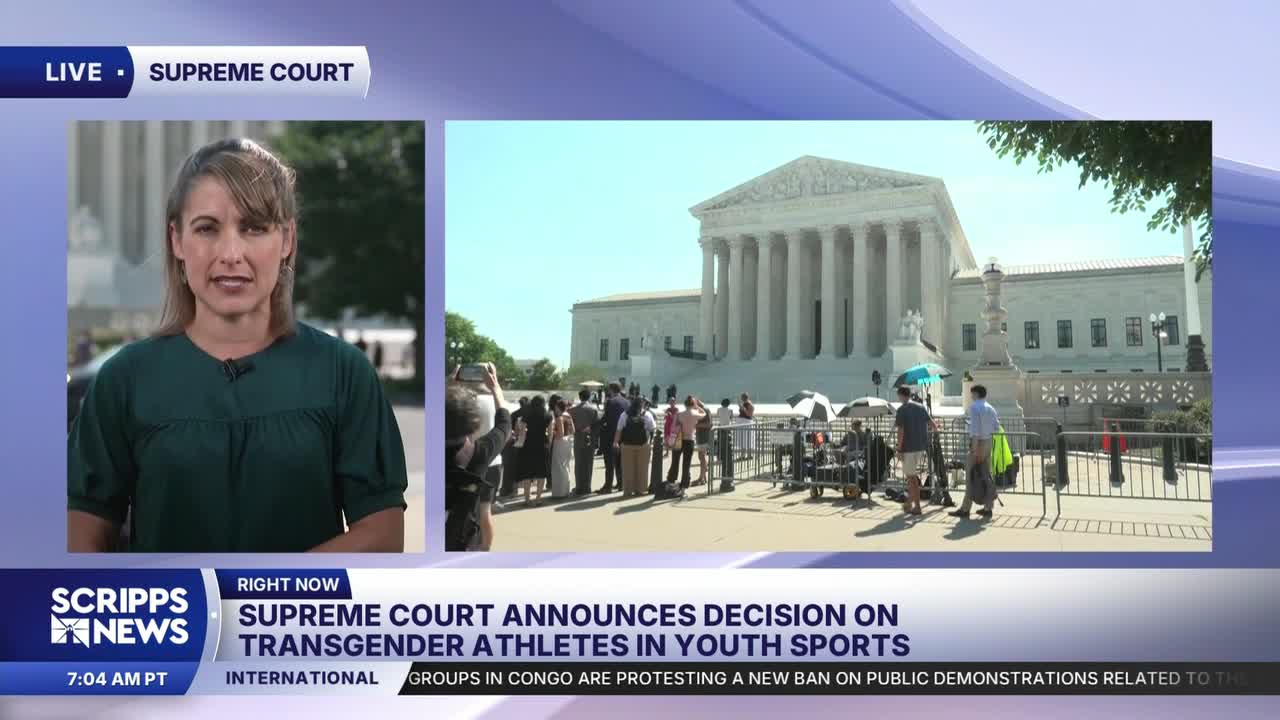


The Supreme Court upheld laws that prohibit transgender women and girls from competing on women’s and girls’ sports teams in schools.
The court's conservative majority decided that state bans, passed in Idaho in 2020 and West Virginia in 2021, do not violate the Constitution or Title IX, a federal law prohibiting discrimination in education based on gender.
Justice Brett Kavanaugh delivered the 6-3 opinion of the court, with Chief Justice John Roberts and Justices Clarence Thomas, Samuel Alito, Neil Gorsuch and Amy Coney Barrett agreeing. Justices Sonia Sotomayor, Ketanji Brown Jackson and Elena Kagan agreed with some parts of the opinion, while disagreeing with other parts outlined in dissenting opinions.
More than two dozen other Republican-led states have adopted bans on female transgender athletes, and the decision seems certain to extend to them as well.
RELATED STORY | IOC bans transgender women athletes from competing in the Olympics
In Idaho, a woman named Lindsay Hecox challenged the state’s law in court because she wanted to be able to try out for the women’s track and cross-country teams at Boise State University as a transgender woman. Hecox’s lawyers wanted the court to dismiss the case because she had forsworn trying to play on women’s teams.
Meanwhile, in West Virginia, the mother of a teenager, who has identified as a girl since she was in third grade and has been issued a West Virginia birth certificate recognizing her as female, filed a case against the state laws that prohibit her daughter from competing on track and cross-country teams at school.
The teen, identified as Becky Pepper-Jackson but known in the case as BPJ, has taken puberty blockers to prevent the onset of male puberty, as well as hormone therapy with estrogen, according to court documents.
Pepper-Jackson has progressed from a back-of-the-pack cross-country runner in middle school to a statewide champion in the shot put. She beat the second-place finisher by two feet in last month's West Virginia championship meet. She is the only transgender athlete who has sought to compete in girls' sports in West Virginia.
West Virginia passed the "Save Women's Sports Act" in 2021, which required public schools and colleges to designate sports teams based on biological sex at birth. The law prevented the teen from competing on her middle school's sports teams.
RELATED STORY | Trump admin demands California ban transgender athletes in girls' sports
Before reaching the Supreme Court, the Fourth Circuit Court of Appeals overturned a lower court's decision to uphold the ban in April 2024, claiming it violated Title IX protections.
West Virginia argued that separating sports by biological sex is essential to ensure fair competition and the protection of athletes.
Lawyers for Pepper-Jackson argued that such distinctions generally make sense but that their client has none of those advantages because of the unique circumstances of her early transition.
