

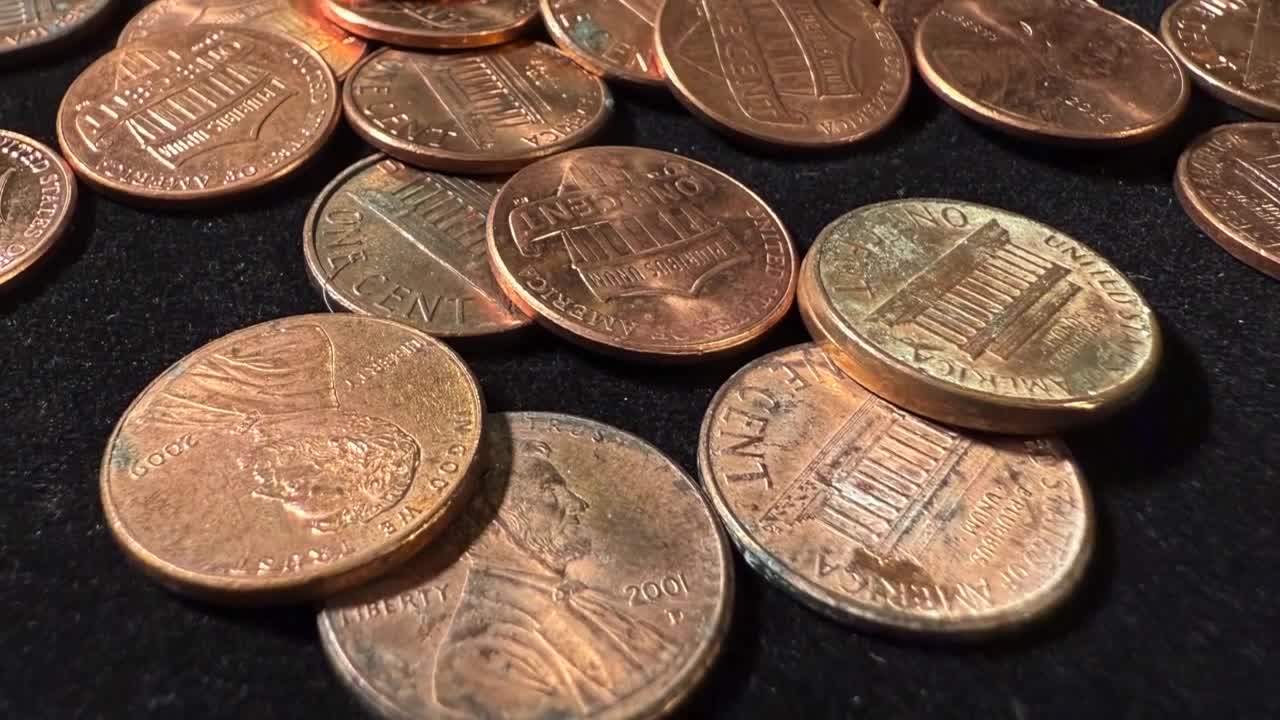


WHITE MARSH, Md. — Pennies are no longer being produced, and businesses are now being forced to decide how to handle cash transactions. After the U.S. Treasury halted penny production last summer because of rising costs, nearly 4 cents to make a 1-cent coin, banks are running short, leaving retailers to navigate checkout decisions without clear federal or state guidance.
"We were no longer getting pennies delivered to us. The bank told us it would be coming and sure enough, a couple weeks later, we haven't seen a penny," said Leslie Richardson, president of Richardson Farms in White Marsh, Md.
Richardson activated a rounding option already programmed into his registers. Under his system, purchases ending in 1 or 2 cents round down to the nearest 5 cents, while amounts ending in 3 or 4 cents round up. The same pattern applies to 6-7 cents (round down) and 8-9 cents (round up).
"Yes, we'll still take pennies. They are still legal tender, but for the most part we don't have them unless somebody gives them to us," Richardson said.
Jeff Lenard, spokesman for the National Association of Convenience Stores, refers to the situation as "the great penny mess."
"What happens is when you get change, you stick it in a jar, you stick it in an ashtray, you stick it somewhere else, it doesn't recirculate. So, the problem with pennies is that when there's not many around, you need constant new pennies. That's not happening right now, and that's why we have this shortage," Lenard said.
The shortage creates difficult choices for retailers, according to Lenard.
"Do you round in the customer's favor and risk losing a couple cents? Do you round up and down and risk somebody being unhappy because they don't understand the system?" he said. "We estimate with convenience stores, if every store rounded in favor of the customer, it'll cost our industry roughly a million dollars a day."
Federal legislators have introduced the Common Cents Act, which would standardize rounding policies nationwide using the same system Richardson employs. However, no vote has been scheduled on the bill.
The proposed legislation follows examples from countries like Canada and Australia, which have successfully implemented rounding systems for years.
"Canada went about this differently. They went through a full year-long process of education and then transition. This has been done differently, but that doesn't mean we can't catch up," Lenard said.
Some shoppers have expressed concerns about the new policies. Phyllis Atkins-Mackey was surprised when she first encountered a rounding sign at Richardson's store.
"I was surprised when I walked in one day and saw the sign posted about rounding my purchase up to the nearest nickel without even asking me. Do I want to donate it to charity? Do I want to do something else? What if I already have my exact change?" Atkins-Mackey said.
Richardson's data shows the rounding system actually favors customers over time. His point-of-sale (POS) system tracks all rounding transactions.
"Our POS system actually keeps track of the rounding, and in a week's time, the customer has gotten $1.51 from us," Richardson said. "We've lost $1.51 over a week, which is cheaper than buying pennies."
While the math statistically evens out, Lenard says customer trust remains the bigger challenge.
"If the customer doesn't know, the default is distrust, and that's where you kind of need to explain the situation and say we're doing the best we can right now," he said.
Atkins-Mackey believes better communication and standardized policies would help consumers understand the changes.
"If we just take a moment to think about some of the impacts and issue some guidance and some policy, so it's not different every store that you walk in," she said.
The Treasury Department is now encouraging shoppers to spend pennies they have at home and recommends retailers round cash transactions to the nearest 5 cents. However, the department says businesses should continue accepting pennies and providing penny change when possible.
The nickel faces similar production cost challenges, costing nearly 14 cents to manufacture each 5-cent coin. While there's been debate about whether the nickel should be next to go, no official decisions have been announced. According to the U.S. Mint 2024 Biennial Report to the Congress, it costs around 6 cents to produce the dime and 15 cents to make and distribute the quarter.
This story was reported on-air by a journalist and has been converted to this platform with the assistance of AI. Our editorial team verifies all reporting on all platforms for fairness and accuracy.