



BALTIMORE — Baltimore City is changing how it handles decommissioned police vehicles after three damaged or totaled Baltimore Police Department vehicles were mistakenly auctioned with their police markings still intact.
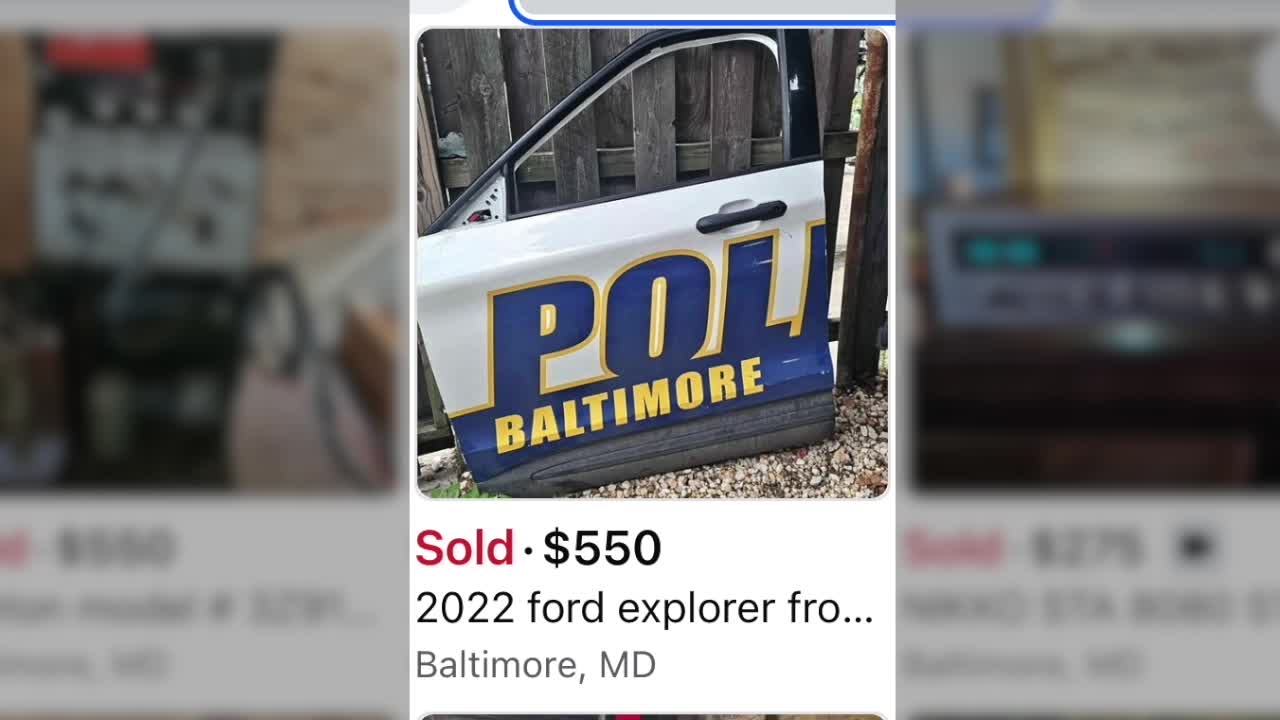
WMAR-2 News found several Baltimore Police vehicle parts listed for sale on Facebook Marketplace, including doors still displaying BPD markings.
One listing offered a rear door for $550. A front door sold for $550, while a pair was listed for $650. The seller described the parts as “battle tested on the streets of Baltimore.”
We traced the parts back to vehicles sold through the government auction website GovDeals earlier this year. Auction photos show three accident-damaged or totaled BPD vehicles still displaying police markings.
The Department of General Services said the vehicles had been designated to be sold for parts only.
Normally, DGS Fleet personnel are responsible for removing emergency lighting, license plates or tags, agency decals and other identifying markings before a decommissioned vehicle is released for disposition.
That didn't happen with these three vehicles.
“DGS determined that the three assets proceeded through the disposition process because of an administrative oversight that occurred during the transition to a new auction platform,” the agency told WMAR-2 News Mallory Sofastaii. “The required decommissioning verification was not completed before the assets were listed for sale.”
DGS said it became aware of the Facebook postings on June 30 and reviewed other recently processed BPD vehicles. According to the agency, these three were the only vehicles it identified as having gone through the auction process with their markings still intact.
Jamie Sadler owns Signs in One Day and has experience printing police decals.
“I've seen people who have decommissioned vehicles. They never have any decals on them,” Sadler said. “They have some of the stuff inside, some of the weird things that they customize for the police vehicles, but the decals, I've never seen that.”
Sadler said police departments use specialized reflective vinyl for the markings.
“The police department, they require it to be reflective like a stop sign, so the light hits it, it lights up,” Sadler said. “So that's one of the most expensive vinyls that we carry here. So it is very, very expensive to create those decals.”
He also explained that an existing police decal generally can't simply be peeled off a door and transferred to another vehicle.
“When you remove that kind of decal, it's trash at that point,” Sadler said. “It stretches and, you know, there's just no way for the adhesive to go back onto something else. So no, you'd have to make a whole new one.”
Creating a convincing replacement isn't necessarily a simple at-home project either.
“I don't think a guy is going to do this on a Cricut type of a thing,” Sadler said. “A machine like this is what you would need to print that kind of decal.”
In this case, however, the original markings are still attached to the vehicle parts.
BPD and DGS said that raises a potential public-safety issue.
“Such markings could potentially be installed on another vehicle or used in a manner that may cause members of the public to believe the vehicle or its occupants are affiliated with BPD,” the agencies said in a joint statement, citing “potential public-safety concerns, including police impersonation or confusion during an encounter with law enforcement.”
DGS told Sofastaii a Fleet employee attempted to contact the person selling the vehicle parts on Facebook Marketplace and asked that the remaining decals be removed.
“The seller did not respond to our request,” DGS said. “DGS will continue its attempts to reach out to the Facebook seller, and if a response is received, work with them to coordinate removal of the decals.”
The seller did respond to Sofastaii but did not agree to an interview. He told her the vehicle was “purchased from a municipal auction” and that he “bought it for parts.” He also said he has paperwork substantiating the purchase.
The incident is also prompting changes to how DGS handles decommissioned vehicles.
The agency said it is reviewing and updating its end-of-service checklist to require verification that all agency decals, asset numbers and other identifying markings have been removed before an asset is released for disposition.
DGS will also require photos of all four sides of each vehicle after the decals are removed and before it is listed for auction.
The agency said it is also reinforcing its decommissioning procedures, documentation requirements and quality-assurance expectations with Fleet employees involved in selling surplus vehicles.