




BALTIMORE — Federal investigators have revealed disturbing details about a sophisticated romance scam operation based in Cambodia, where thousands of workers allegedly targeted Americans through fake online relationships.
Cambodian police dismantled the compound earlier this year with intelligence provided by the FBI. The case comes as reported romance scam losses hit a record $943 million in 2025, prompting a new interagency awareness campaign ahead of Valentine’s Day.
Inside a plain office building in Cambodia, investigators found thousands of people trained to build trust with Americans before stealing their life savings.
"This is a whiteboard that was found in a scam compound in Cambodia in January," said Keith Custer, supervisory special agent with FBI Baltimore.
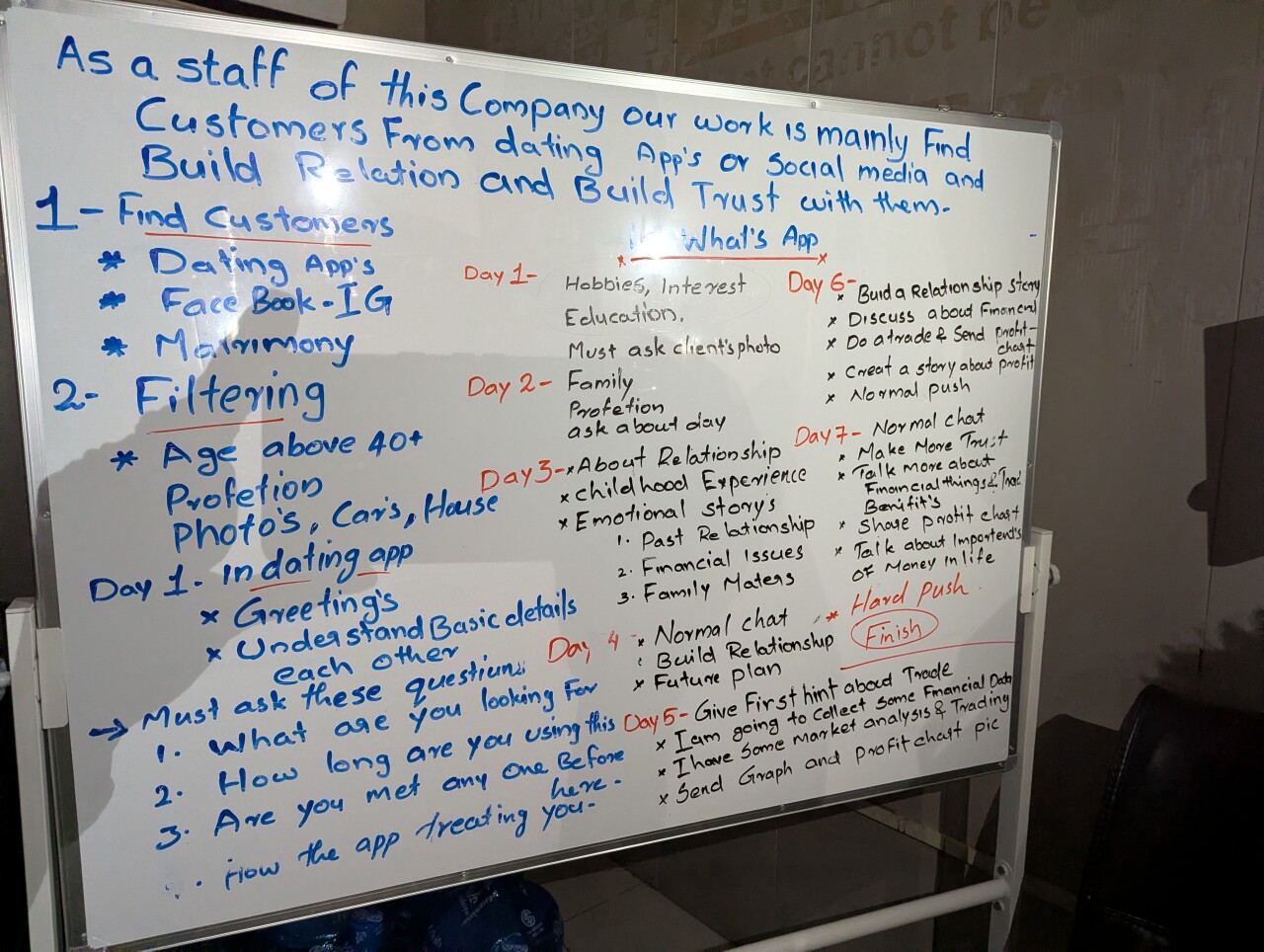
The whiteboard detailed the scammers' playbook, including how to find victims and a day-by-day plan to manipulate them.
"As a staff of this company, our work is mainly find customers from dating apps or social media and build relationships and build trust with them," Custer said, reading from the scammers' materials. "So they're looking for age 40 plus. They're looking for profiles that demonstrate that a person has a certain level of wealth by examining their photos."
"Why do they call [victims] customers," asked WMAR-2 News Mallory Sofastaii.
"I mean, that's kind of the mindset is that crime is a business and the business is scamming people," Custer said.
Romance scam losses surge 35%
The profits from these operations continue growing. According to preliminary data, in 2025, the FBI's Internet Crime Complaint Center received more than 24,000 romance scam complaints nationwide with reported losses topping $943 million. That represents a 35 percent increase from 2024, when losses totaled $699 million.
Investigators say scammers exploit relationships to push victims onto fake cryptocurrency and trading sites, promising big financial gains.
One Maryland man lost $35,000 after what started as a simple text from a stranger. He responded "wrong person," but they kept talking.
"Chit chatting about family and where we've been, what we kind of do during our lives," the victim said.

An In Focus look at 'Romance Scam' numbers in Maryland
After a week, she told him about an investment opportunity. The fake trading platform showed impressive returns.
"So I made about $150,000," the victim said. And he says that happened in just one month.
But when he tried to cash out, he was told he first needed to pay taxes and additional fees.
"It gives the victim the illusion that they're in control of their investments," Custer said.
Warning signs and prevention
Custer says scammers will work their victims until they have nothing left, which is why more than a dozen federal agencies have launched a national awareness effort called “Dating or Defrauding?” The campaign, announced ahead of Valentine’s Day, is designed to educate the public about so-called relationship investment scams where fraudsters use emotional connections to lure victims into fake cryptocurrency or trading platforms.
"They'll try to isolate the victim from friends and family. They'll tell them to keep things secret and not to advertise it. There'll always be a sense of urgency to act quickly," Custer said. "You know, people still need love and it's a powerful force in the world and unfortunately these people have turned it toward nefarious purposes."
Custer added that scammers are using artificial intelligence to mask accents and sound more convincing. In some cases, investigators believe the people carrying out these schemes may themselves be victims of human trafficking, forced to scam to earn their freedom.
The FBI advises never sending money to someone you haven't met in person. If something feels off, talk it over with someone you trust or contact the FBI. And report all scams to the FBI's Internet Crime Complaint Center.
More information and resources about relationship investment scams are available at CFTC.gov/LearnAndProtect.
This story was reported on-air by a journalist and has been converted to this platform with the assistance of AI. Our editorial team verifies all reporting on all platforms for fairness and accuracy.