

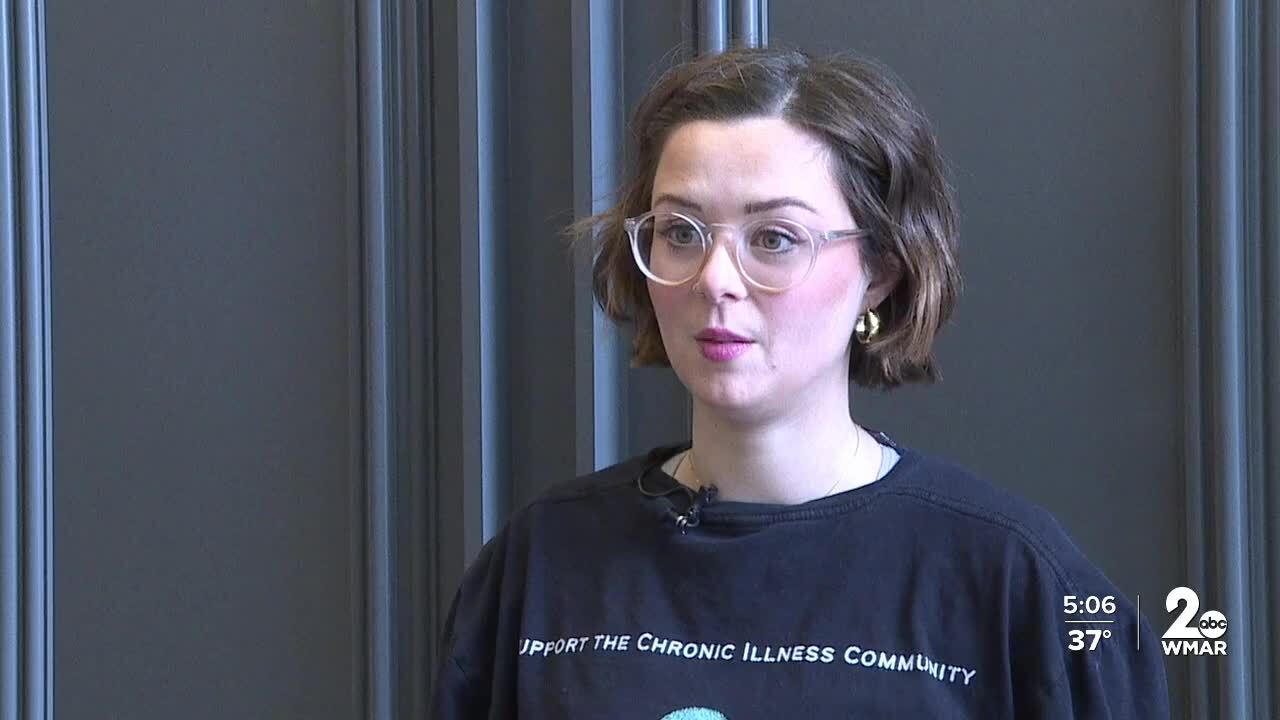


BALTIMORE — Lexi Marta was diagnosed with neuromyelitis optica spectrum disorder in college. Now she's using her own experience to help others with rare diseases.

WATCH: Rare disease patient becomes researcher to help others
Marta's diagnosis — a condition similar to multiple sclerosis that affects the nervous system — came just before her senior year of college. Rather than letting it derail her future, she used it to shape one.
After completing her bachelor's degree, Marta pursued a master's in nutrition from Johns Hopkins Bloomberg School of Public Health, supported in part by the RAREis Scholarship from the EveryLife Foundation for Rare Diseases. A scholarship supported by Amgen.
"My diagnosis is neuromyelitis optica spectrum disorder. It's very similar to MS so it causes symptoms with your nervous system," Marta said.
Following graduation, Marta became a clinical research coordinator, where she ran a drug trial and worked directly with patients facing their own rare disease journeys.
"I got to see patients every single day, and I got to listen to their stories and help them through their diseases, and because I was also going through the same thing or similar, it was really easy to have a conversation with them," Marta said.
But her progress was interrupted when her condition began to worsen.
"It was a really beautiful time in my life and unfortunately, though, that was cut short because of the way that my disease progressed. It cost a lot of other health issues and I did end up in the hospital for a month in a coma with COVID-19 and pneumonia and sepsis and all of that really fun good stuff. And it forced me to take a step back from research for a bit to focus on my health," Marta said.
Despite the setback, Marta says she has no intention of stopping.
"My goal ultimately is to go back and get my PhD and then bring my nutrition knowledge into the world of chronic illness and address misinformation within that," Marta said.
Her story is exactly the kind the EveryLife Foundation for Rare Diseases had in mind when it created its scholarship program. Stephanie Riordan, who works with the foundation, says financial and systemic barriers often follow rare disease patients well into adulthood.
"Because people with rare diseases have so many barriers, especially financial barriers to care and access in treatment, that by the time it comes to college and careers, sometimes those barriers impact the career path, so this is really an opportunity to alleviate those barriers," Riordan said.
Riordan says the scholarship holds personal meaning for her as well.
"I actually got diagnosed with my own rare disease when I was in college and it was right before my senior year and so the scholarship has a really special place in my heart because of my own diagnostic odyssey," Riordan said.
The EveryLife Foundation is opening applications on March 17 for the upcoming fall semester. Anyone over 17 who has a rare disease and needs support is encouraged to apply.
This story was reported on-air by a journalist and has been converted to this platform with the assistance of AI. Our editorial team verifies all reporting on all platforms for fairness and accuracy.
