

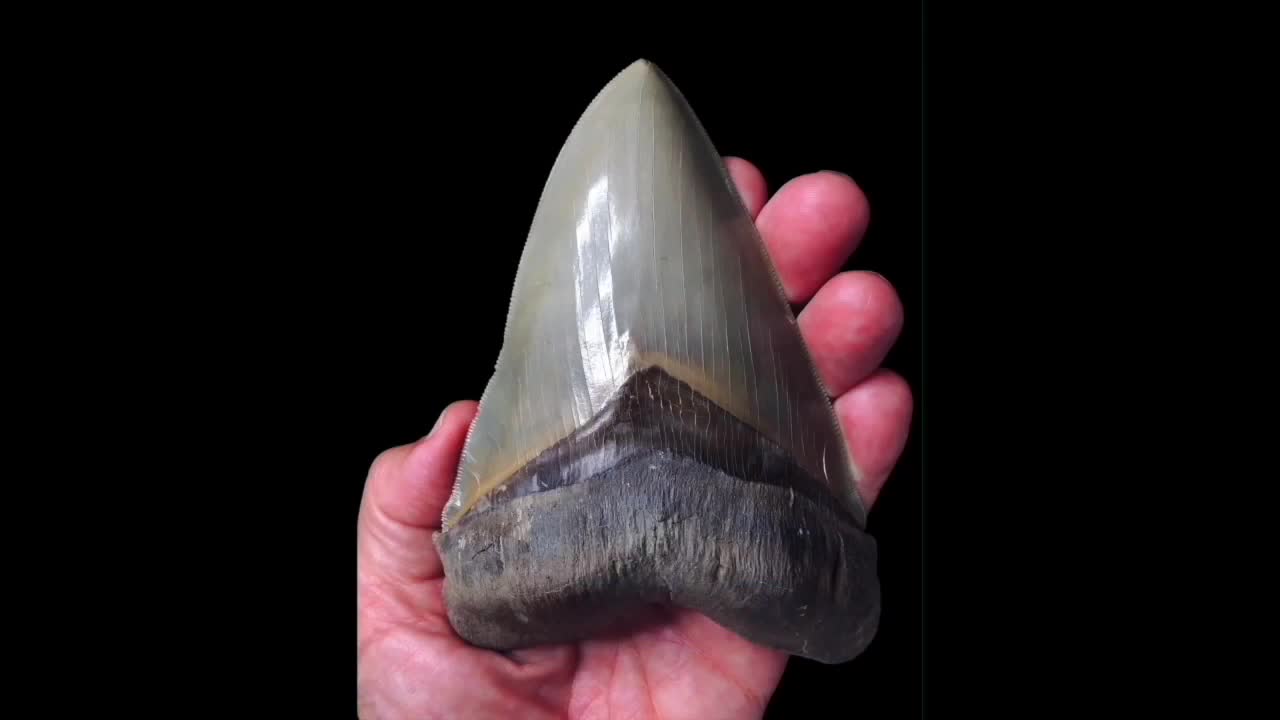


CALVERT COUNTY, Md. — Millions of years ago, the megalodon ruled the waters as the largest and fiercest predator, using its massive, powerful jaws and rows of razor-sharp teeth to take down its prey.
Today, megalodon teeth the size of a human hand are found on beaches along the Chesapeake Bay. And Dr. Stephen Godfrey believes its footprint, or teethprint, in Maryland makes it worthy of being designated as the state shark.
"Turns out no state has a state shark, so we’re hoping Maryland is the first," said Godfrey, who is the curator of paleontology at the Calvert Marine Museum in Southern Maryland.
Godfrey said he and his colleague, John Nance, were talking about megalodon and the idea came up to make it the state shark. They drafted up a bill and sent it to Sen. Jack Bailey and House Delegate Todd Morgan, who filed it to be considered during this year's legislative session.
"To me, this is such an iconic animal. I think its time for megalodon to take center stage as the first shark designated as a state shark," he said.
Megalodon lived from 20 million years ago up to three and a half million years. It swam in waters that covered the Atlantic coastal plain, which includes Maryland, said Godfrey.
Its teeth have been found in several counties including Anne Arundel, Caroline, Calvert, Charles, Dorchester, Prince George's and St. Mary’s. A popular spot to find them is along Calvert Cliffs in Southern Maryland.
The Calvert Marine Museum has a number of them on display, including associated megalodon teeth, which Godfrey said came from one individual shark that died and many of its teeth were buried in one place.
"I can see no downside to the excitement that this shark can generate, both for the education and the interest in both fossils in Maryland, as well as a better understanding of the living sharks that are present both in the Chesapeake Bay and coastal waters," he said.
Godfrey hopes to get a group together to testify in Annapolis during the session in support of the bill.

