


BALTIMORE — Could anti-choking devices be coming to a school near you?
That’s what one Baltimore County delegate wants to see, years after a deadly incident in Anne Arundel County. Six years ago Bowen Levy, a non-verbal special needs student, choked to death on a rubber glove at school.
“We’ve got to get a teacher with a tool in their toolbox,” Delegate Ric Metzgar (R- District 6) said.

Delegate continues push for anti-choking devices in schools, despite bill's failure this session
Moved by Levy’s story, Metzgar pre-filed a bill this session in his name that would require each Maryland school to have an airway clearing device on site, similar to a law already on the books in Texas. It was also cross-filed in the Senate by the Senator who represents the same district, Johnny Ray Salling.
“This could literally be personal. It could be somebody of our family,” Sen. Salling (R-District 6) said. "You have an option that you can save a life and make a difference."
“I support this bill so that… no one is left with the lifelong guilt that they could not save a choking child,” parent Kimya Davani testified during a Ways and Means hearing on January 29.
Despite early hearings in the session, movement stalled, and the bills did not survive crossover day. Though Metzgar, who already anticipated the possibility, says he’s undeterred.
He’s continuing to work with LifeVac, a company that claims to have saved 5,000 lives with its anti-choking device and a supporter of the bills, to coordinate donations.
"I’m a salesman. I do what I can to save a life," Metzgar said.
It wouldn’t be the first time that the company has donated its products, which are typically marketed for $70 each.
“I couldn’t let people keep dying over money,” Arthur Lih said.
According to a fiscal notes, the cost to stock all 1,400 schools in Maryland with at least one device would cost taxpayers $85,200.
Lih is the CEO and inventor.
“I had heard of a 7-year-old that choked to death. My daughter was 7, the back blows and chest compressions, and abdominal thrusts didn't work, and the child died,” Lih said. “So I went to Home Depot, and I got a sink plunger, and I glued a mask on it with tape, and I made the first LifeVac.”
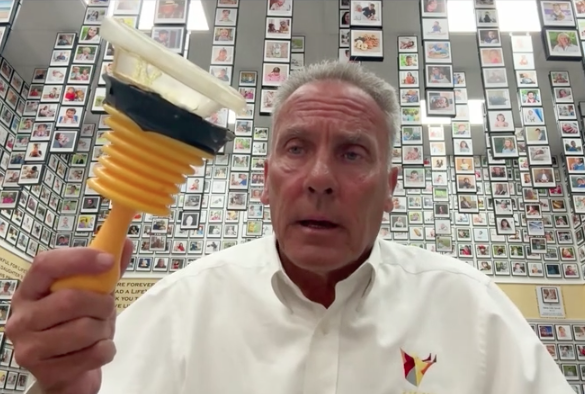
While marketed as a life-saver, the device has been under intense scrutiny in recent years, Lih even received a warning letter from the FDA last fall to cease marketing of the product due to concerns about “public health and safety.”
That was the reason why the Maryland Teachers Union did not support the bill.
But Lih claims the company was already working to get FDA approval, and the letter helped remove copycats on Amazon that weren’t going through the same motions to get the invention approved as a Class Three device.
“That took about 2.5 years, a couple million dollars, and we had to basically do an independent study on every aspect,” Lih explained.
As of March, it received FDA approval under an entirely new classification.
It’s the first of its kind to be approved as a second-line treatment when traditional choking protocol doesn’t work. The same day as the update, the FDA reiterated that the public should still follow standard life-saving measures first.
"Established choking rescue protocols from the American Red Cross and the American Heart Association have a high success rate and should be used during a complete airway block emergency. Using an anti-choking device may involve steps such as having to remove it from its packaging and assembling it before use. The time to complete these steps and use an anti-choking device could delay use of established rescue protocols," the agency shared online.
To date, the device is still not endorsed or recommended for use by any medical organization.Lih says he’s been “begging” the Red Cross to include it in its First Aid and CPR training.
“I hope that this changes,” Lih said. “Because we could save a lot more lives.”
While the company has recorded many successes through customer testimony, by providing a free replacement in exchange, there are some reports where the device has failed to work. The FDA also notes that it is aware of reported issues, including "lack of suction, bruising around the face, lips, and mouth, and scratches in the back of the throat."
Earlier this year in Houston, rescue efforts that involved the use of an airway clearing device failed to save an eight-year-old choking on a grape.
Lih claims it had not been used properly in that case.
“I don't know why you do 100 back blows and then use the LifeVac twice. Our recommendation and the FDA’s is 5 [back blows] minimum,” Lih said.
The founder says they’re working to reemphasize proper training in the device, and Metzgar is already planning to re-introduce the Bowen Levy Airway Clearing Device Act next session in Annapolis.