


BALTIMORE — A mother says she was shocked when her 5-year-old son was experiencing strange and worrisome symptoms after he was dropped off at school, but what she found out next she couldn’t believe.

WATCH: Kindergartner hospitalized after exposure to cannabis
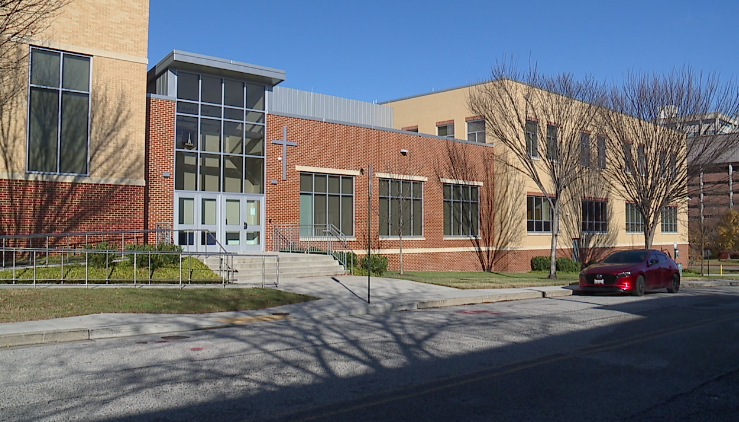
Latasha Woods says she took her son, Emmanuel, to the Mother Mary Lange Catholic School on MLK Boulevard the Wednesday morning before Halloween, just after 8:00. A little after 9 a.m., she received a call from the school that her son was having chest pains, a high heart rate and was walking strangely.
"He wasn't really responsive. It was, two adults on either side of him walking him up, like making him walk. His eyes were like rolled into the back of his head," she explained.
She rushed her son to the hospital, where several tests were conducted. His toxicology report came back with the answer: positive for cannabinoids.
"How is that even a possibility? How is that even one of the things that could have been the thing?" Woods said.
She explained to WMAR-2 News' Blair Sabol that there was no possibility he could have had access to edibles in the home. They had also stayed at a friend’s house the night before, which she also says there would be nothing there.

She said her son told her, during a rare lucid moment, that he had been given a piece of sour candy by another student in his class. Her first thought was to alert the school, and her son’s teacher. But Woods said she was met with dismissal, or no response at all.
"The standards were too low for me where he was, and so I switched him here," Woods said. "And now, the trust is broken."
Woods also questions why the school didn't immediately call 911.
"What if it was cardiac or what if it was a stroke, or what if it was him falling into a diabetic coma?" Woods asked "Their response was inappropriate."
The school responds
The Archdiocese of Baltimore Department of Catholic Schools said the school "immediately conducted a thorough investigation" that led to "inconclusive" results. Without finding a violation of their anti-drug policy, evidence of a controlled substance on campus or risk to other students, parents were not notified.
"We take seriously the allegation that a kindergarten-aged student may have received a food item from another student that impacted his health," director of marketing and communications Bill Geibler wrote in an email to WMAR-2 News. "If any evidence of a controlled substance had been found on campus or a risk to other students was identified, we would have notified the entire school community."
Geibler wrote that students' belongings were checked and security footage was reviewed, which showed no inappropriate candies or the opportunity for the child to obtain one.
WMAR-2 News requested an opportunity to independently review the footage, which was denied.
See their full response below:
Whenever possible and when it can be accomplished safely, we prioritize giving families control over their children's health decisions. That means, when the symptoms presented allow, we contact the parents to pick up the child so that they can determine the correct next steps in consultation with their personal health care providers. So, although our schools certainly are empowered to call 911 in emergencies, this is not an appropriate default response to students experiencing health impacts that are not life-threatening.
We take seriously the allegation that a kindergarten-aged student may have received a food item from another student that impacted his health. In this case, we immediately conducted a thorough investigation. I’d like to share some of the information we found and how the school went about this:
- An aide and teacher reported that no other food except breakfast items were consumed by the student while on campus.
- No other students demonstrated or reported similar symptoms.
- We reviewed internal video footage that reflected the child’s movements during his brief time at school that morning (less than an hour, as he arrived late for the school-day). The footage did not show any opportunity for him to receive any inappropriate candies.
- Other students’ belongings were inspected, and none were in possession of any inappropriate candies, nor did we receive reports of such possession.
- The parent shared that her son could not recall the identity or grade of the peer who allegedly provided the food item.
- Despite requesting, we did not receive a response from the family for additional information from the child’s medical providers regarding the nature or cause of symptoms.
Ultimately, we were unable to determine the source of the child’s symptoms or where he might have obtained something that could have caused them. As a result, our investigation was inconclusive.
Our school policy strictly prohibits the use or possession of drugs and controlled substances; however, we could not verify that this policy was violated. If any evidence of a controlled substance had been found on campus or a risk to other students was identified, we would have notified the entire school community. Student safety remains our highest priority at Mother Mary Lange Catholic School, and we will continue to reinforce safety expectations and awareness of our policies.
This information was never provided to Woods, who removed her son from the school shortly after the incident.
"Maybe nobody wants to be at fault for something like this," Woods said. “I feel like they were trying to put it on me because it was so early in the morning, but I know what I have in my house. I know what I did all the way up until then."
Increasing underage cannabis exposure in legal states
Cases of children being exposured to cannabis have increased in Maryland, according to Dr. Brian Schultz, a Johns Hopkins pediatric emergency medicine doctor and medical toxicologist.
"These products are very widespread. They're used by many people. Recreational cannabis use is legal in the state of Maryland now, so people have easy access to them," Schultz said.
Common symptoms can include drowsiness, nausea, and vomiting, with children being at high risk for severe symptoms of respiratory depression and seizure.
Woods noted that Emmanuel needed extra oxygen and wasn't able to expel carbon dioxide while in the hospital.
Research backs Schultz' observations.
"It's almost like you see it on a daily basis," Schultz said.
Last year, Maryland increased its requirements to make cannabis packaging more clearly labeled and child-resistant. But once products are out of their original packaging, it can be hard to tell the difference between edibles and food items that are enticing to children.
Schultz said it's not just the look but also the dosage that can be dangerous for kids.
"They might ingest a really large amount of them and end up getting sometimes 30 to 40 times or even higher the dose that an adult might take," Schultz said."It's almost like this, some of them are rushing to be able to make like the most concentrated product, when in reality if an adult wants to use it they're gonna use the dose that they want to use. They don't need to have a 500 mg brownie."
Though research has not shown any long-term consequences for young children, according to Shultz, the acute symptoms can be especially scary for families.
That was the case for Woods, who says her son wasn't able to be roused for several hours in the hospital.
"I feel like it's like having a loaded gun in the house because it is dangerous. If you have a gun, you know you're gonna keep it far away from your children, locked up so they can't get to it. Edibles and other things that are infused with marijuana needs to be handled the same way," Woods said.
According to mom, Emmanuel is mostly back to normal, though she's noticed some changes like a slower, delayed response. He's been scheduled for more tests.
"He used to be really, really quick and I hope that he gets back to how he was before, but I don't really know," Woods said.
Shultz does point out that repeated daily use of marijuana is especially concerning among teens.
"They can develop something called cannabinoid hyperemesis syndrome, which is something we never saw years ago, and we see all the time now where in people who use cannabis extraordinarily heavy, developed this severe, almost intractable abdominal pain and nausea," he explained. "It's only relieved by stopping."
This story was reported on-air by a journalist and has been converted to this platform with the assistance of AI. Our editorial team verifies all reporting on all platforms for fairness and accuracy.