


BALTIMORE — Nearly one month after a sewer line collapsed causing mass overflow of wastewater into the Potomac River, President Donald Trump said he's seen enough.
It all began January 19 when the Potomac Interceptor burst resulting in more than 200 million gallons of sewage to make its way into the river.
While located in Montgomery County, Maryland, the Potomac Interceptor is owned and operated by DC water- a Washington, D.C. based utility company.
That didn't stop Trump from placing blame on one of his most outspoken critics, Maryland Governor Wes Moore.
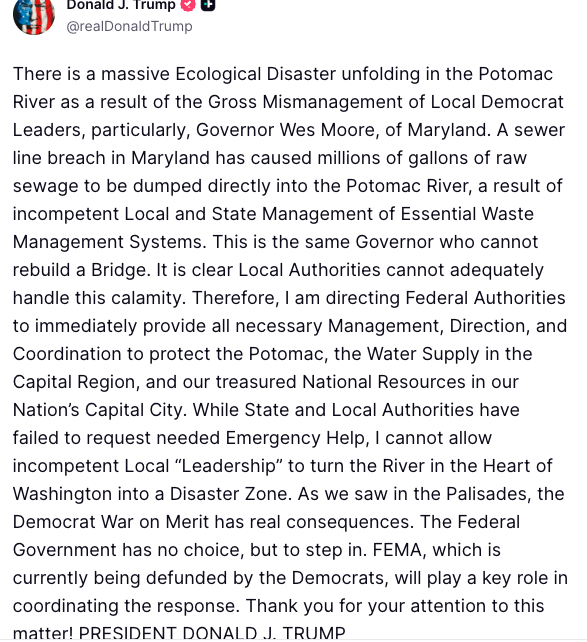
"There is a massive Ecological Disaster unfolding in the Potomac River as a result of the Gross Mismanagement of Local Democrat Leaders, particularly, Governor Wes Moore, of Maryland," Trump wrote on his Truth Social platform Monday afternoon. "This is the same Governor who cannot rebuild a Bridge."
The President claims local officials failed to ask for emergency federal assistance.

Moore responded on Tuesday, saying Trump "has his facts wrong."
The Governor suggested the federal Environmental Protection Agency (EPA) has oversight of the Potomac Interceptor's infrastructure.
It appears Trump is now planning to take action, closing out his Truth Post like this...
"I cannot allow incompetent Local “Leadership” to turn the River in the Heart of Washington into a Disaster Zone. As we saw in the Palisades, the Democrat War on Merit has real consequences," Trump's post reads. "The Federal Government has no choice, but to step in. FEMA, which is currently being defunded by the Democrats, will play a key role in coordinating the response."
In the meantime, DC Water created a temporary bypass rerouting wastewater back into the sewer system.
So far drinking water isn't believed to be impacted.
"The nearest Virginia locality using the Potomac River as a primary source of water is Fairfax," the Virginia Department of Health's website states. "Fairfax Water's Potomac River intake is located several miles upstream of where the sewage spill enters the Potomac and is therefore not impacted."
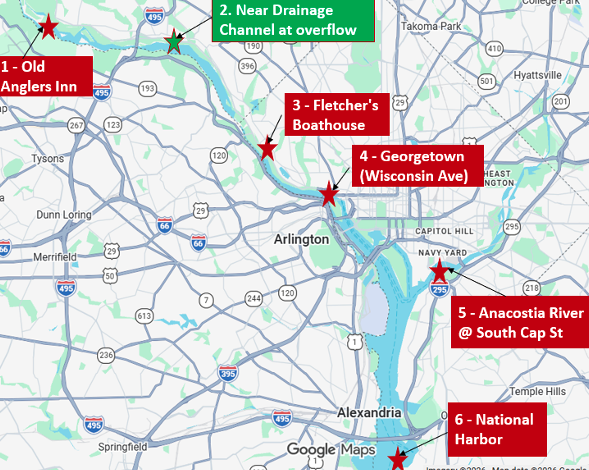
The State of Virginia did, however, issue an advisory urging residents "to avoid recreational water activities in the Potomac River, such as swimming, wading, tubing, white-water canoeing or kayaking, where full-body submersion is more likely to occur."
The advisory extends 72.5 miles from the Fairfax County side of the American Legion Memorial Bridge (I-495) to the King George County side of the Route 301 (Harry W. Nice Dahlgren) Bridge.
As for Maryland, their Environment Department already issued a precautionary closure of shellfish harvesting from the Port Tobacco River in Charles County through the Route 301 (Harry W. Nice Dahlgren) Bridge bordering Virginia.
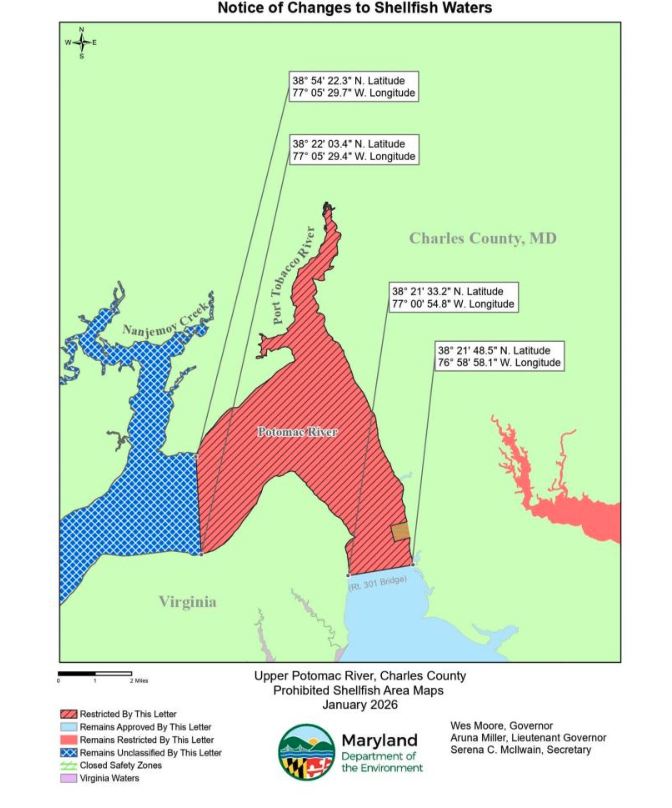
At this point Virginia officials say their shellfish growing areas are not affected by the sewage spill.
Maryland's most recent testing indicates decreased bacteria levels with significantly lower concentrations farther downstream from the spill site.
DC Water said it could take up to six weeks for full repairs to be made.
For updates, click here.
