

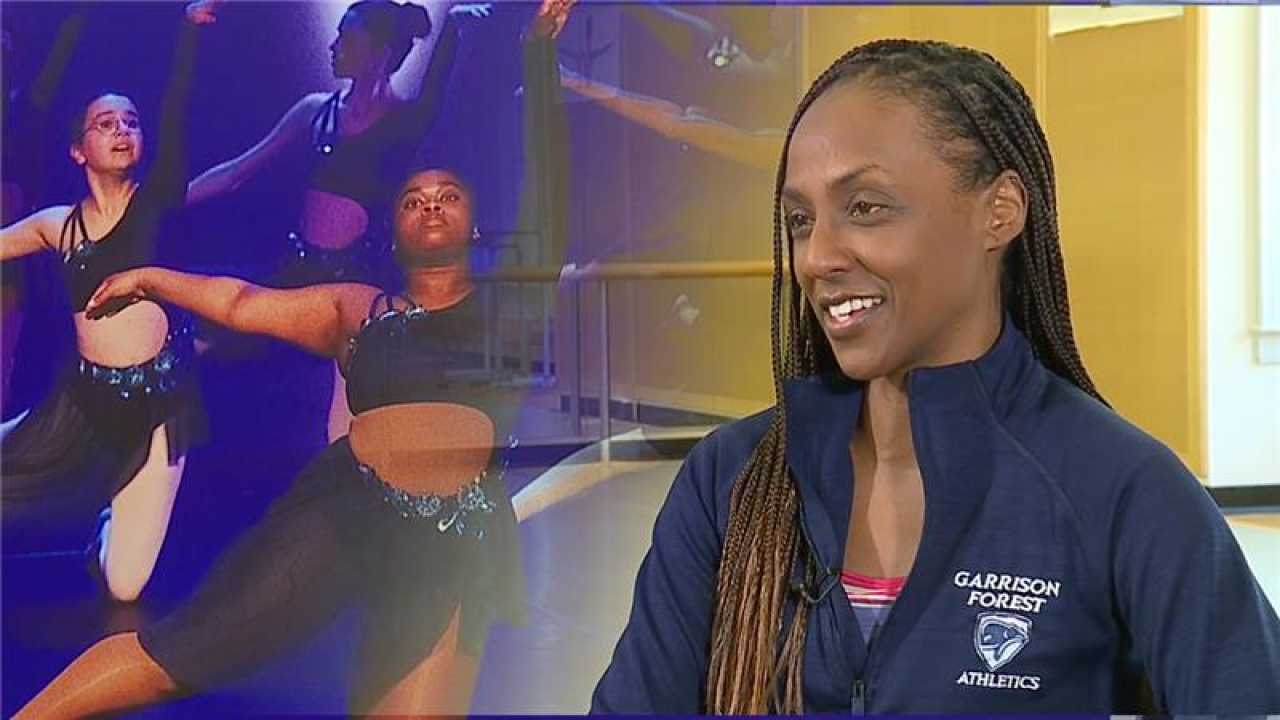


OWINGS MILLS, Md. — Dance can be defined in a multitude of ways — as a form of expression, an art form, and as defined by Merriam-Webster, the movement of one's body rhythmically, usually to music.
But for others like Ms. Heather Malone-Wolf, it's a storytelling tool. For Malone-Wolf, who initially dreamed of becoming the first woman to play in Major League Baseball, there was something about dance that called to her, even as she remained deeply committed to education.

The Spirit of Dance: How Heather Malone-Wolf made history and now shapes future performers
"I feel like when you're in the performing arts, it's more about a spiritual thing than just movement and just steps," said Malone-Wolf. "I went to Garrison first. I was a student here, and the dance department back then was subpar. In eighth grade, I knew I wanted to become a professional ballet dancer."
After recognizing her passion, Malone-Wolf left Garrison Forest and enrolled at the Baltimore School for the Arts for high school. Already two years ahead academically, she knew BSA would provide the artistic training she needed. She added that the instructors there treated her like a true professional.
"From day one, there are no bells, there are no teachers to tell you where to go. It is for the students in Baltimore who are driven in their performing arts," Malone-Wolf said.
Her time at BSA emboldened Malone-Wolf to pursue dance professionally, positioning her to make history. She became the first African American Clara in the Oakland Ballet's Nutcracker — a moment she describes not as a dream coming true, but as something she worked incredibly hard to achieve.
From hearing stereotypes about what dancers should look like to understanding that the journey for an African American woman to become a ballet dancer is exceptionally difficult, Malone-Wolf knew that being on that stage meant more than just a performance.
"Once I was on stage, I'll never forget — a grandmother, mother, and granddaughter came up to me, and the grandmother said, 'I've been taking my daughter here (I think she was in her 30s or 40s) to the show since she was seven, and I've never seen somebody who looked like me on stage.' She said, 'My granddaughter turned to me and said, Mommy, I want to be just like her.' So that was the moment where I said, 'Now the torch is being passed, and I have weight on my shoulders to show other little girls that they can do this too,'" Malone-Wolf said.
This understanding from that pivotal performance led to her current role at Garrison Forest, where Malone-Wolf has taught dance for 14 years. At the school, she now produces her own Nutcracker performance — a yearly tradition she began two years ago alongside two close friends every second week of December.
She says she's always intense during rehearsals, but her students notice a difference. "They tell me, 'It's a studio, Miss Heather, and it's a theater, Miss Heather.' I think I'm the same, but they're like, 'Oh no, Miss Heather, when you're in the theater, you're a different person.' I'm like, 'Okay, but I'm always intense,'" said Malone Wolf.
It's because she cares so deeply that she continues pushing the next generation toward greatness. She wants to see each student succeed, caring for them as if they were her own children.
While her teaching career continues, Malone-Wolf will keep the spirit of dance alive at Garrison Forest, already knowing how she wants to be remembered when its all said and done.
"It's more than dance. It's more than me. It's more than students. It's finding a person in your life like my mentor who says, 'I see you' — and you don't have to be the best dancer. You could take my class for one semester, but if you have that person who says, 'I see you and I recognize you and you are important,' I think that's the legacy I'd like to leave."
